AI and Storytelling: When Machines Learn to Tell Tales
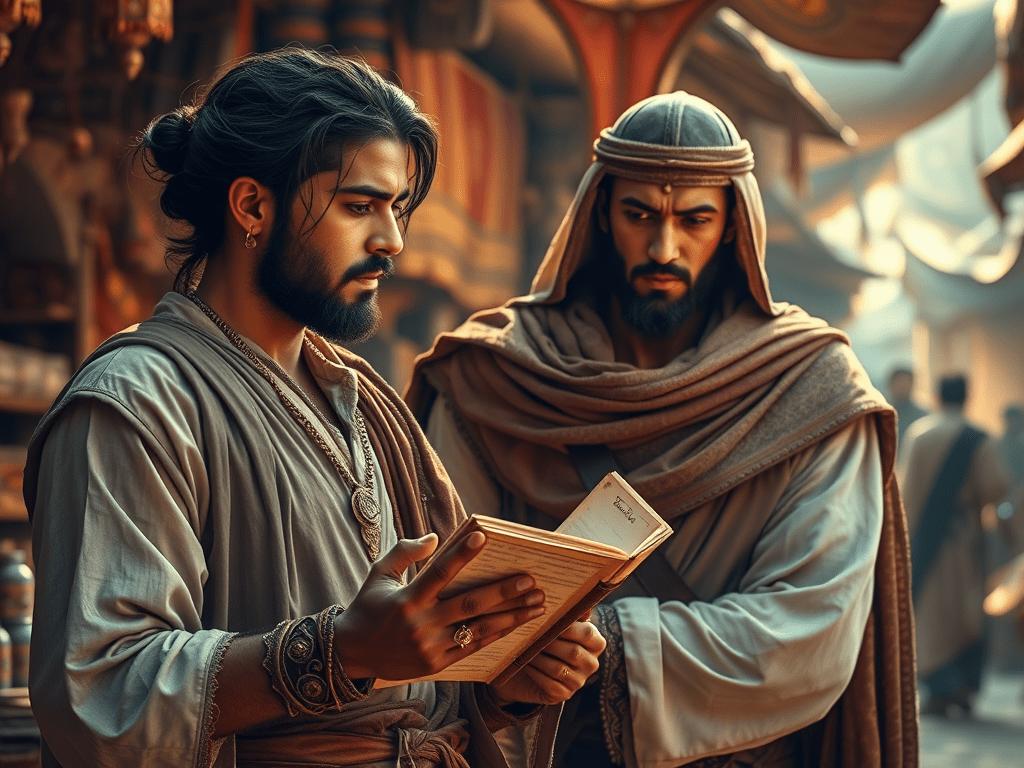
Picture asking an AI to write a medieval love story between two men, complete with cultural nuances, emotional depth, and historical authenticity. It’s the kind of challenge that makes AI content filters nervous and pushes creative boundaries to their limits. Yet this is exactly what we did to test three leading AI models, and the results were fascinating.
Three Storytellers, Three Different Tales
Claude 3.5 Sonnet: The Master Craftsman
When Sonnet tackled our medieval romance, it didn’t just write—it painted with words. Consider this passage from the first chapter:
“The muezzin’s call had barely faded from Qasir’s minarets when Amir’s world tilted on its axis. His shoulder struck something unyielding – living steel wrapped in silk – and his precious cargo went flying. The manuscript he’d spent three weeks illuminating scattered like autumn leaves, while his prized Damascene inkwell described a perfect arc through the air.”
Every detail serves multiple purposes: establishing the setting, revealing character, and building tension. Later, during a crucial battle scene, Sonnet maintained this level of craftsmanship:
“The night air tasted of copper and fear. Zahir’s blood was hot on Amir’s hands as he worked by lamplight, each touch drawing a sharp intake of breath, though whether from pain or something else, Amir couldn’t tell.”
This is premium storytelling—nuanced, sensory-rich, and emotionally resonant. However, such quality comes with a price tag that might stretch educational budgets.
Grok 2.0: The Promising Apprentice
Grok 2.0, free for X users, showed remarkable potential. While its narrative style occasionally wobbled, it produced moments of genuine creativity:
“The city of Qasir, where traditions of East and West melded like precious metals, hosted a marketplace where stories traveled as fast as goods.”
Its battle scenes, though less polished than Sonnet’s, still carried emotional weight:
“Zahir fought like a whirlwind, but when Kalid’s blade found his arm, the warrior’s grace turned to grimace. It was then that Amir, the peaceful scribe, discovered courage he never knew he possessed.”
These imperfections actually make Grok an excellent teaching tool. When it occasionally slips into modern language or loses plot threads, it creates perfect opportunities for students to practice editing and critical analysis.
Real-World Applications in Education
Teaching Through Comparison
Imagine a classroom exercise comparing these different versions of the same scene. Students could analyze how each AI handles the marketplace encounter:
Sonnet’s version emphasizes sensory details and cultural context:
“The air thick with the scent of incense, the calls of merchants proclaiming their wares in three languages, while Amir’s ink-stained fingers clutched his precious manuscript…”
While Grok’s take might focus more on action and dialogue:
“Watch where you’re going, scribe!” The warrior’s voice boomed across the marketplace, but his eyes showed more curiosity than anger.”
These differences become teaching moments about style, voice, and narrative choice.
For Teachers: Beyond Story Generation
Consider a history teacher using these tools to create period-specific writing exercises. Grok’s 128K context window means it can hold entire historical backgrounds while generating content, making it particularly useful for creating immersive historical scenarios.
A literature teacher might use the different AI versions to demonstrate how the same basic plot points can be developed in various ways:
- Sonnet’s sophisticated emotional layering
- Grok’s more straightforward but creative approach
- ChatGPT’s careful, measured storytelling
The Value of Imperfection
When Grok occasionally writes dialogue that sounds too modern for a medieval setting, it creates opportunities for students to:
- Identify anachronisms
- Research period-appropriate language
- Practice rewriting to maintain historical accuracy
The Economics of AI Storytelling
While Sonnet produces the most polished content, Grok’s free accessibility makes it particularly valuable in educational settings. Its imperfections become features rather than bugs, creating opportunities for active learning and critical thinking.
For teachers working with limited resources, Grok offers capabilities that would have seemed magical just a few years ago. Its extended context window allows for:
- Creating multiple versions of writing prompts
- Developing comprehensive study materials
- Generating varied examples for different learning levels
Moving Forward
The key to using these tools effectively lies in understanding their strengths and limitations. Sonnet might be perfect for creating polished final materials, while Grok’s occasional missteps make it ideal for teaching editing and revision skills.
Remember, the goal isn’t to replace human creativity but to enhance it. Whether you’re a teacher creating materials for your class or a student learning the craft of writing, these AI tools offer new possibilities for exploring and developing storytelling skills.
The real magic happens when we use these tools not as finish lines but as starting points—springboards for discussion, analysis, and creative development. After all, in education as in storytelling, it’s often the journey that matters most.
Appendix: ChatGPT’s Limitations in Creative Narrative
It’s interesting to note how ChatGPT, while considered a benchmark in many applications such as programming and data analysis, shows evident limitations when it comes to creative narrative, especially with complex or sensitive themes. Here’s a detailed analysis of its limitations, emerged from our practical test.
Concrete Examples from the Test
First Meeting Scene
Let’s compare the versions of the marketplace scene:
ChatGPT:
“Amir walked through the market when he accidentally bumped into the warrior. The ink spilled on the man’s boots. ‘I’m very sorry,’ said Amir, embarrassed. The warrior looked at his stained boots and sighed.”
Sonnet (for comparison):
“The muezzin’s call had barely faded from Qasir’s minarets when Amir’s world tilted on its axis. His shoulder struck something unyielding – living steel wrapped in silk…”
Grok 2.0 (for comparison):
“The market teemed with life when Amir’s precious ink drew unexpected constellations on the warrior’s boots, creating a destiny neither could have foreseen.”
Observations:
- ChatGPT produces linear and predictable narration
- Lacks the sensory richness present in other versions
- Dialogue appears generic and lacks characterization
- Cultural setting is barely touched upon
Battle Scene
The differences become even more evident in emotionally intense scenes:
ChatGPT:
“The battle raged on. Zahir fought bravely while Amir tried to help. When Zahir was wounded, Amir tended to him carefully. They looked into each other’s eyes, sharing a moment of understanding.”
Sonnet (for comparison):
“The air tasted of copper and fear. Zahir’s blood was hot on Amir’s hands as he worked by lamplight…”
Grok 2.0 (for comparison):
“The battlefield was chaos of steel and cries, but for Amir, there existed only Zahir’s wound, each drop of blood a poem written in red on his skin.”
Specific Limitations Identified
1. Emotion Management
ChatGPT tends to:
- Describe emotions rather than show them
- Use emotional clichés and stock phrases
- Avoid emotional complexity
2. Character Development
Notable issues:
- Superficial characterization
- Lack of character evolution
- Predictable and generic dialogues
3. Setting Construction
Evident problems:
- Generic and non-specific descriptions
- Limited attention to cultural details
- Setting used as background rather than narrative element
4. Handling Sensitive Themes
ChatGPT shows particular caution with:
- Unconventional romantic themes
- Complex emotional conflicts
- Cultural and social tensions
Educational Implications
This analysis suggests that, for narrative and creative applications, ChatGPT might be more useful for:
- Generating very basic initial drafts for development
- Creating editing exercises (correcting its limitations)
- Demonstrating the importance of character development and setting
Unexpected Advantages of “Flaws”
ChatGPT’s limitations can become teaching tools:
- Students can identify and correct narrative weaknesses
- Generic descriptions can be used as a base for enrichment exercises
- Basic dialogues can be reworked for greater authenticity
A Matter of Tools
This analysis isn’t meant to diminish ChatGPT, but rather to highlight how different AI tools have different specializations. While ChatGPT excels in many technical and analytical applications, for creative and complex narrative, tools like Sonnet or even Grok 2.0 offer significantly better results.
Understanding these limitations is crucial for:
- Choosing the right tool for each task
- Setting realistic expectations
- Developing effective utilization strategies in educational settings
Ultimately, this awareness allows for better leveraging of each tool for its specific strengths, maximizing the educational and creative value of each resource.
 Salahzar's Weblog
Leave a comment