
OCR fedele di un libro dalla scansione delle pagine, con gpt4o:
Methodologia: uno scan per ogni pagina e richiesta a Geppino (gpt4o) di analizzare l’immagine. Ho confrontato questo con l’OCR tradizionale, e la capacita’ di estrazione testo di Geppino e’ risultata superiore. Allego il risultato del confronto, qui original OCR e’ quella di gpt4o, confrontata con Yandex che usavo sistematicamente negli anni passati:
Confronto:
Accuratezza della punteggiatura e della spaziatura:
L’OCR con gpt4o cattura il testo con la punteggiatura e la spaziatura corrette, mentre l’OCR tradizionale presenta alcuni problemi come spazi mancanti (“realismbut“, “motiona running horse“), punteggiatura errata (“objects.“) e punti casuali (“. . .“).
Chiarezza del contenuto:
Entrambi i risultati dell’OCR trasmettono lo stesso contenuto nel complesso, ma l’OCR con gpt4o è più chiaro e rappresenta il testo in modo più accurato senza errori.
Note a piè di pagina:
L’OCR con gpt4o include le note a piè di pagina indicate con numeri, mentre l’OCR tradizionale ha perso questi indicatori.
Errori tipografici:
L’OCR tradizionale introduce più errori tipografici (ad esempio, “Yo of a second” invece di “1/10 of a second“).
Paragrafi:
Entrambe le versioni mantengono la struttura del paragrafo, ma l’OCR tradizionale presenta alcuni problemi di spaziatura e interruzioni (ad esempio, “improvements in the state of the art” inizia con una virgola seguita da “It,was“).
Conclusione:
L’OCR con gpt4o è più accurato e fedele al testo reale sulla pagina, con meno errori e un formato più chiaro. L’OCR tradizionale presenta diversi problemi con la punteggiatura, la spaziatura e gli errori tipografici che influenzano la leggibilità e l’accuratezza.
Page 1.

Introduction to the Dover Edition
“The great panorama of life is interesting because it moves.” — J. Bell Pettigrew, 1873.
As the nineteenth century progressed, both scientists and artists sought with increasing avidity the graphic representation of motion that was too fast for the human eye to see, and too extreme for any model to pose. The search was spurred by physiologists who strove to comprehend the way animals move, and by those artists who equated truth to nature with art.
The invention of photography in 1839 seemed to be a crucial step toward the scientific rendering of appearances—toward quintessential realism—but from the very introduction of the medium, the camera’s inability to record moving figures was lamented, even while its success in reproducing the minutest detail of still objects was hailed as a triumph. A correspondent of the Foreign Quarterly Review, while praising all the architectural details that were visible in one of the first daguerreotypes seen by the public, L. J. M. Daguerre’s view of a Parisian boulevard, commented in 1839: “In foliage he is less successful, the constant motion in the leaves rendering his landscapes confused and unmeaning… the same objection necessarily applies to all moving objects…”
It was not until two decades later that improvements in the state of the art made it possible for the camera to record motion under ordinary light. By then, the photographic process had been made “instantaneous” enough to record human figures performing what now seem to us relatively slow movements (walking, bending, stepping into a carriage, for instance). These figures, caught by the camera while they were strolling in the sun on the streets and boulevards of London and Paris, were seen in pairs of small photographs mounted on a card for viewing in the stereoscope. Although these stereographs were advertised as “instantaneous” views by the London Stereoscopic Company, the exposure time used for them was about 1/10 of a second. The figures in these photographs were tiny and seen from a distance, and their motion had been successfully stopped only when it lay along the line of vision. And faster motion—a running horse, a turning wheel, a man running or walking very fast—was still recorded as a series of connected blurs. “Instantaneity,” which really meant taking a photograph in as brief a time as was then possible, was not yet “instantaneous” enough to stop these motions, even on a small plate. As Lake Price, an English photographer, noted in 1858, optical and chemical improvements were still needed to so accelerate the photographic process that “any dimension and class of picture may be taken instantaneously.”
Eadweard Muybridge, a British photographer working in California, was the first to photograph fast motion. That was in 1872. In 1878 and 1879, continuing his experiments in California, he so accurately photographed successive phases of the stride of trotting and running horses that the individual photographs could be synthesized—set in smooth and continuous motion in his zoopraxiscope, a projection machine, or in one of the existing devices, the so-called “philosophical toys,” that demonstrated the principle of the persistence of vision. In 1883, the University of Pennsylvania invited Muybridge to perform further investigations, more elaborate and extensive than his previous ones. This he did, working for three years under the university’s auspices at an experimental setup on the grounds of its hospital, across the street from its new Veterinary School, and at other locations in Philadelphia.
The university published the results of his work in 1887 under the title Animal Locomotion. These are the plates that are reproduced here, part of 781 presented together for the first time since their original publication. The plates were originally printed by a form of gelatin relief called collotype, similar in appearance to photogravure, and were sold in portfolios, or “copies,” of 100 plates each. The complete set of 781 plates, printed on fine linen paper measuring 19 by 24 inches, could be had in eight portfolios for $600. Only 37 “perfect” sets of the complete work were produced. This monumental work, composed of 19,347 individual photographs, is the “completion,” as Muybridge later said, of his photographic investigation of human and animal locomotion.
The results of his work deeply affected artists and scientists at the time of their publication; Animal Locomotion, his “electro-photographic investigation of consecutive phases of animal movements,” is still the most exhaustive pictorial analysis of the subject ever made, and still the dictionary of forms to be used in questions on the appearance of men and animals in motion.
The history of Muybridge’s stop-motion photography is one of extraordinary twists and turns, a history as strange as his biography (with which it is, of course, so intimately intertwined).
Page 2.
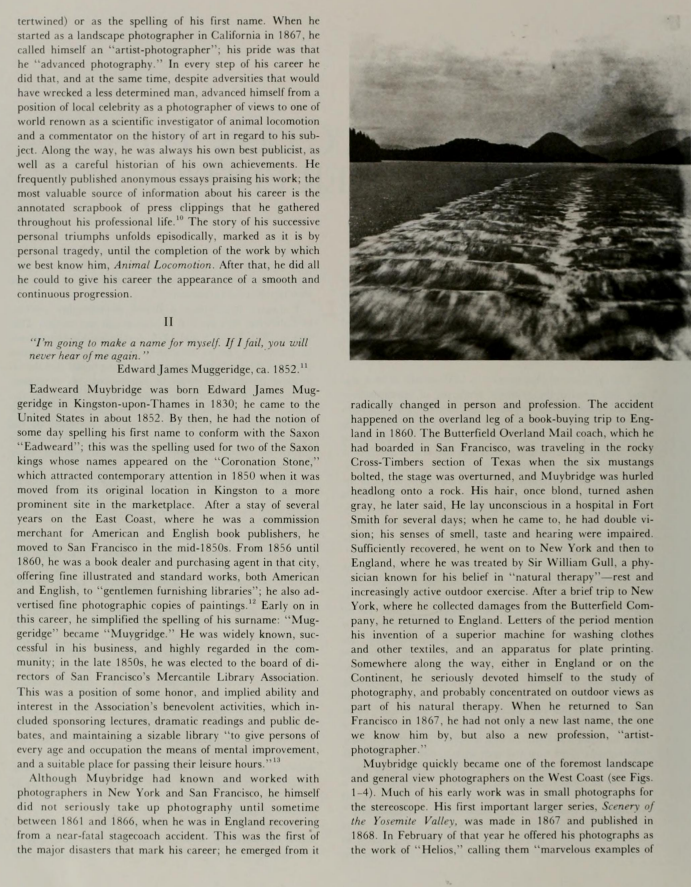
…intertwined) or as the spelling of his first name. When he started as a landscape photographer in California in 1867, he called himself an “artist-photographer”; his pride was that he did “advanced photography.” In every step of his career he said that, and at the same time, despite adversities that would have wrecked a less determined man, advanced himself from a position of local celebrity as a photographer of views to one of world renown as a scientific investigator of animal locomotion and a commentator on the history of art in regard to his subject. Along the way, he was always his own best publicist, as well as a careful historian of his own achievements. He frequently published numerous essays praising his work; the most valuable source of information about his career is the annotated scrapbook of press clippings that he gathered throughout his professional life. The story of his successive personal triumphs unfolds episodically, marked as it is by personal tragedy, until the completion of the work by which we best know him, Animal Locomotion. After that, he did all he could do to give his career the appearance of a smooth and continuous progression.
II
“I’m going to make a name for myself. If I fail, you will never hear of me again.”
— Edward James Muggeridge, ca. 1852.
Eadweard Muybridge was born Edward James Muggeridge in Kingston-upon-Thames in 1830; he came to the United States in about 1852. By then, he had the notion of some day spelling his first name to conform with the Saxon “Eadweard”; this was the spelling used for two of the Saxon kings whose names appeared on the “Coronation Stone,” which attracted contemporary attention in 1850 when it was moved from its original location in Kingston to a more prominent site in the marketplace. After a stay of several years on the East Coast, where he was a commission agent for American and English book publishers, he moved to San Francisco in the mid-1850s. From 1856 until 1860, he was a book dealer and purchasing agent in that city, offering fine illustrated and standard works, both American and English, to “gentlemen furnishing libraries”; he also advertised fine photographic copies of paintings. Early on in his career, he simplified the spelling of his surname: “Muggeridge” became “Muybridge.” He was widely known, successful in his business, and highly regarded in the community; in the late 1850s, he was elected to the board of directors of San Francisco’s Mercantile Library Association. This was a position of honor, and implied ability and interest in the Association’s benevolent activities, which included sponsoring lectures, dramatic readings and public debates, and maintaining a sizable library “to give persons of every age and occupation the means of mental improvement, and a suitable place for passing their leisure hours.”
Although Muybridge had known and worked with photographers in New York and San Francisco, he himself did not seriously take up photography until sometime between 1861 and 1866, when he was in England recovering from a near-fatal stagecoach accident. This was the first of the major accidents that mark his career; the accident radically changed him in person and profession. The accident happened on the overland leg of a book-buying trip to England in 1860. The Butterfield Overland Mail coach, which he had boarded in San Francisco, was traveling in the rocky Cross-Timbers section of Texas when the six mustangs bolted, the stage was overturned, and Muybridge was hurled headlong onto a rock. His hair, once blond, turned an ashen gray; he later said. He lay unconscious in a hospital in Fort Smith for several days; when he came to, he had double vision; his senses of smell, taste and hearing were impaired. Sufficiently recovered, he went on to New York and then to England, where he was treated by Sir William Gull, a physician known for his belief in “natural therapy”—rest and increasingly active outdoor exercise. After a brief trip to New York, where he collected damages from the Butterfield Company, he returned to England. Letters of the period mention his invention of a superior machine for washing clothes and other textiles, and an apparatus for plate printing. Somewhere along the way, either in England or on the Continent, he seriously devoted himself to the study of photography, and probably conceived the notion of views as part of his photographic new career. When he returned to San Francisco in 1867, he had not only a new last name, the one we know him by, but also a new profession, “artist-photographer.”
Muybridge quickly became one of the foremost landscape and earned view photographers on the West Coast. His early work in small photographs for the stereoscope. His first important large series, Scenery of the Yosemite Valley, was made in 1867 and printed in 1868. In February of that year he offered his photographs as the work of “Helios,” calling them “marvelous examples of…
Page 3.

…the perfection to which photography can attain in the delineation of sublime and beautiful scenery,” and “the most artistic and remarkable photographs ever produced on this coast.”
As he would for his later photographs of figures in motion, he offered these Yosemite views to subscribers in portfolio; he particularly emphasized the interest of local artists and connoisseurs in his work, hoping to encourage sales by listing their names—Charles Nahl, William Keith, Juan B. Wandesforde, Norton Bush among them—in his broadsides.
The press, both local and national, agreed with Muybridge’s estimation of Helios’ photographs. The San Francisco Alta California reported on 17 February 1868: “The views surpass in artistic excellence, anything that has yet been published in San Francisco. . . . In some of the series we have just such cloud effects as we see in nature or oil-painting, but almost never in a photograph.” And the leading American journal of photography, The Philadelphia Photographer, was full of praise for his first major photographic production. In the issue of November 1869, the editor noted:
Through the kindness of Mr. Edward J. Muybridge, San Francisco, California, who has loaned us the negatives, we are enabled to present our readers with a view in the great Yosemite Valley, California. . . . To photograph in such a place is not ordinary work. It differs somewhat from spending a few hours with a camera in Fairmount or Central Park. All the traps, and appliances, and chemicals, and stores, and provender, have to be got together, and then pack mules secured to carry the load, and drivers to have charge of them. Thus accoutered, the photographer starts out, say, from San Francisco, through hill and vale, across deep fords, over rugged rocks, down steep inclines, and up gorgeous heights, for a journey of one hundred and fifty miles. Several days are thus occupied, and several nights are spent far away beyond the road. . . . “Helios” has outdone all competitors. . . .
III
“It is an important point to consider, that it is useless for photographers to endeavor to increase the energy of their sensitive surfaces, when the chemicals required are not manufactured with that purity and exactitude so absolutely necessary to ensure their success.”
— Frederick Scott Archer, 1852.
The comments of both the Alta California and The Philadelphia Photographer glance at the difficulties of producing photographs by the wet-collodion method, which Muybridge used for all of his published work until the investigations of 1884-1886 at the University of Pennsylvania. Indeed, it was these difficulties that eventually made Muybridge believe that the photographic study of men and animals in motion that he had made using wet-collodion plates in California in the late 1870s should be “completed,” or done over again, using the more sensitive and handier gelatin process that by the early 1880s had come into general use.
This should provide a clear and complete continuation of the text from the second page and the third page of the document.
Page 4.

We had an opportunity of looking last evening at some very fine large-sized photographic negatives representing some of the most picturesque views of Yosemite Valley. . . . They are the production of Edward Muybridge.
Muybridge stayed only briefly in Sacramento, which lies about 200 miles northwest of Yosemite; in May, he advertised his forthcoming Yosemite series in San Francisco, and by July he was back at work in the Valley. It was during this short stay that the artist met the railroad builder and began the collaboration that would lead, eventually, to the first photographic analysis of motion.
What Stanford wanted in 1872 was a photograph of his fast horse Occident trotting at full speed. He had a theory, gathered from close observation, that a trotting horse at some point in its stride has all four feet off the ground at the same time. He had tried various mechanical ways of registering the horse’s footfalls; none were successful. It was then that he called upon the most publicized and best-equipped photographer on the West Coast. Muybridge was “perfectly amazed at the boldness and originality” of the proposition. He later amplified his initial response, explaining fully his amazement at Stanford’s charge to him, and quite frankly describing its outcome. In an excerpt from an essay that he published anonymously, he also reveals his knowledge of the problems Stanford set him to solve, his grasp of public relations and his flair for dramatic monologue:
Mr. Stanford startled the photographer by stating that what Mr. Stanford desired was a photograph of his horse, Occident, and taken while the horse was at full speed. No wonder even the skilled Government photographer was startled, for at that date, the only attempts that had ever been made to photograph objects in motion had been made only in London and in Paris, only by the most consummate masters of the art, and only in the most practicable street scenes. And even in these scenes in which the photographs show no objects moving faster than the ordinary walk of a man had been attempted, and in which the legs had not been essayed at all, the objects were taken as they moved towards the camera, in which action, owing to the laws of perspective, the continuous change of place was less noticeable. Occident was immediately the fastest trotter in the whole world, having recorded a mile in 2:16½, which was faster than even the skipping Goldsmith Maid had done. And the picture required to be taken, not as the flyer should bear down on the camera, but as his driver should shoot him at fullest speed past the lens. Mr. Muybridge therefore plainly told Mr. Stanford that such a thing had never been heard of; that photography had not yet arrived at any such wonderful perfection as would enable it to depict a trotting horse at speed. Mr. Stanford, the firm quiet man who had, over mountains and deserts and through the malignant spleen of the world, built the railroad declared impossible, simply said: “I think if you will give your attention to the subject, you will be able to do it, and I want you to try.” So the photographer had nothing to do but “try.” He thought over the matter, skillfully made all the then known combinations of chemistry and optics for taking an instant picture, made the trial, and succeeded in getting the first shadowy and indistinct picture of Occident at a trot.
This photograph, unfortunately, remained known only to Stanford and Muybridge. Stanford highly lauded it as it was, it was, nevertheless, satisfactory to Stanford. He could read it well enough to consider it proof of his belief that there was a moment of unsupported transit during the stride of a trotting horse. But the photographer wanted something better, something less shadowy, a photograph that would be proof to a wider audience than merely his patron that he was capable of advancing photography. He tried again, in 1873. This attempt was reported in the Alta California for 7 April 1873: “a great triumph as a curiosity in photography—a horse’s picture taken while going the highest fleet in a second!” But, again, the photograph was not published.
In the following year, 1874, two important events affected the Stanford/Muybridge collaboration: the first expanded the photographic experiments, moving them to a higher level of investigation than Stanford had initially envisioned; the second almost put an end to Muybridge’s career, if not to his life.
First came the publication in English of Etienne-Jules Marey’s Animal Mechanism, a Treatise on Terrestrial and Aerial Locomotion, which had appeared in France the previous year under the title La Machine animale. Marey, a professor of natural history at the College de France, had devoted himself to the analysis of animal motion since the mid-1860s. His method was one of graphic notation derived from ingenious recording devices attached to the animal being studied. An early experimental device of Marey’s was the myograph, by which the movement of a frog’s muscle was transmitted to a carbon-blackened cylinder. In Animal Mechanism, Marey said of the shock resulting from the administered impulse that “it is so rapid that its phases cannot be distinguished by the eye, so that, to appreciate its characteristic elements, recourse must be had to special instruments. Registering apparatus can only supply this need, for they faithfully render all the phases of motion communicated to them.” In his study of terrestrial locomotion of biped and quadruped, Marey noted the history of investigations of his subject, and, claiming the method of graphic notation as a scientific advance, stated his belief that its use could lead to the definite resolution of all the mysterious issues of animal locomotion. The apparatus he devised for his study was the “experimental shoe,” an ordinary shoe under the sole of which was another sole of India rubber. Between them was an air chamber, which was compressed when the foot exerted pressure on the ground. The air expelled escaped by a tube into a drum with a lever attached, which registered the duration and the phases of the pressure of the foot. The experimental subject, wearing two such shoes, walked around a table which supported the registering apparatus. With this device, Marey was able to make tracings of the impact and the rise of the two feet during the period of the foot running. Marey added to the experimental apparatus: the subject carried a portable recording instrument, and also wore on his back a drum from which the physiologist obtained tracings of ventral reactions. For the paces of the horse, the apparatus was visualized adapted to the animal’s shoe and foreleg; and the rider carried the chronographic register in one hand; in the other, the reins. Marey’s investigations also included building models of instruments to illustrate the flight of insects and to measure the movements of the wings of birds (see Figs. 5-9).
In translating his graphic notations into readily identifiable images, Marey had the help of Emile Dubouchet, a colonel of…
Page 5
…the French army, and a horseman and student of animal locomotion for some time. Using Marey’s notations, Dubouchet was able to draw the horse at full trot, and in these drawings showed that there is indeed a point in trot when the horse is entirely off the ground. While Marey’s published work was accompanied, in the matter of the horse, by Dubouchet’s drawings as well as by his more abstract “synoptical notations,” this visual representation must have been difficult for the popular mind to accept in an age already accustomed to what the nineteenth century called photography: the exact and truthful witness of the sun. It was the veracity of this witness, this “pencil of nature,” that carried a conviction of accuracy that the errant hand of man could not convey. “The machine cannot lie,” as Stanford later put it.
According to Muybridge, Stanford read Animal Mechanism closely, and no doubt Muybridge did, too, for in almost every phase of his later career, he adapts to his own experiments the outline for the study of animal locomotion set forth in it. As for Stanford, there is one passage in Marey’s publication that could not fail to challenge him: “All the necessary researches into animal locomotion can only be facilitated by men especially interested in these inquiries, and placed in a favorable circumstance to understand them.” Both of these requirements, interest and money, were personified in the wealthy Californian horseman. Marey also made another suggestion, and it was this that expanded the idea of the Stanford/Muybridge collaboration from the achievement of a single instantaneous photograph of fast motion to the hitherto impossible series of photographs of fast motion:
Everyone knows the ingenious optical instrument invented by Plateau in 1832, and also, independently by the Austrian von Stampfer, and called by him “Phenakistoscope.” This instrument, which is also known by the name of Zoetrope, presents to the eye a series of successive images of persons or animals represented in various attitudes. When these attitudes are coordinated so as to bring before the eye all the phases of movement, the illusion is complete; we seem to see living persons moving in different ways. This instrument, usually constructed for the amusement of children, generally represents grotesque or fantastic figures moving in a ridiculous manner. But it has occurred to us that, by depicting on the apparatus figures constructed with care, and representing faithfully the successive attitudes of the body during walking, running, etc., we might reproduce the appearance of the different kinds of progression employed by man.
What more carefully constructed (that is, accurate) figures might there be than those drawn from photographs? If, of course, the photographs could only be taken. Stanford and Muybridge, having had some success in the single shot, determined to try for the photographic series. For Stanford, the data so gathered would be the foundation on which he might build a theory of animal locomotion useful in the breeding and training of fast horses; for Muybridge, the expanded experiment was a further chance to prove his superiority as a photographer and to advance his art.
Any advancement, however, was dramatically curtailed by the terrible event of 17 October 1874. The following account from the Calistoga Free Press for Saturday, 24 October 1874, tells the story:
Early Sunday morning last, the news of a terrible tragedy, which occurred the night previous at about 11 o’clock, at the residence of Wm. A. Stuart, near the Yellow Jacket quicksilver mine, about seven and a half miles west of Calistoga, in this county, was received here. The particulars, as near as we can ascertain, are as follows: On Saturday last, just before the departure of the San Francisco boat for Vallejo, Edward J. Muybridge, a well-known photographic artist in San Francisco, by means of letters which fell into his hands, made the discovery that his wife, who is now in Oregon, and to whom he was devotedly attached, had been for some terms of criminal intimacy, for some time past, with Major Harry Larkyns, formerly connected with several San Francisco journals, but lately engaged in getting up a map of the mines in this and adjoining counties. Frenzied over the discovery, he immediately made his way to Calistoga, and learning here that the destroyer of his peace was at the Yellow Jacket Mine, hired a team at Connolly’s stable, and employed Geo. Wolford to drive him there. Alighting, he knocked at the door, and enquired if Major Harry Larkyns was in. The gentleman that answered the call informed him that he was, and invited him in; he very politely and calmly said, saying he wished to see Major Larkyns only a moment on the outside. The Major, who at the time was engaged in a game of cribbage with a lady, answered the summons. As he opened the door and looked out into the dark, he called out: “Who is it? I can’t see you.” Mr. Muybridge says “Good evening, Major; my name is Muybridge, and here is the answer to the letter you sent my wife,” and fired at the breast of Larkyns. The Major staggered back, and ran through the kitchen and sitting room, and out the front door, and fell close to a large oak tree. Mr. Stacy and others carried him in the house and laid him on a bed, where he breathed his last in about one minute and a half. After firing, Muybridge followed closely, but was met and covered by a pistol in the hands of M. McArthur, and surrendered—though making no attempt to escape—and was brought to Calistoga immediately and given into the hands of Constable Geo. B. Crumwell. We are informed that there was talk of lynching Muybridge at the time of the shooting, but through the influence of Mr. Stuart this extreme of violence was not put into effect.
In an interview given in December in the Napa County jail to a reporter for the San Francisco Chronicle, Muybridge told of his young wife Flora’s acquaintance with Larkyns, a Scotsman whose title, by his own account, came from service with the French army during the Franco-Prussian War. They had met early in 1873, and during Muybridge’s absences from the city, particularly his extended coverage of the Modoc War in April and May of that year, acquaintance became infatuation. The handsome and worldly Major was then turning his varied journalistic writing on art and theater for San Francisco journals, escorted Flora to the theater while the famous English actress Adelaide Neilson was “playing her engagement.” Muybridge made his suspicions known to both of them in the strongest terms, and thought the matter finished. But it was not. On that fatal day, he had received letters from a confidant of the lovers giving proof that the son born in April 1874, when she had named Florado Helios Muybridge, was not, after all, his child…
Page 6.
…the woman with all my heart and soul, and the revelation of her infidelity was a cruel, prostrating blow to me, shattering my idol and blighting the bright affection of my life,” he told the reporter. “I have no fear of the result of my trial. I feel that I was justified in what I did, and that all rightminded people will justify my action.” The interview was published in the Chronicle on 21 December.
Muybridge was tried for murder in the first degree in February 1875. He pleaded not guilty; his counsel pleaded not guilty by reason of insanity, citing the blow Muybridge had received in the stagecoach accident of 1860 as the cause of “mental aberration.” William H. Rulofson, the publisher of Muybridge’s large Yosemite views, testified to his insanity: Muybridge would not take a picture that he was not interested in, no matter how lucrative the commission; and Muybridge had ventured to precipices high above the Valley’s floor in pursuit of views, a disregard of personal safety that no man in his right mind would be capable of. Other witnesses called him eccentric, wavering and excitable. But the prosecution’s witnesses cited his calm behavior in jail and the steadiness of his hand as he poured a drink after his arrest; a doctor from the Stockton Insane Asylum testified that he did not believe him to have been presented. When the case went to the jury, however, the question put was whether or not the homicide was justified. One of the defense attorneys, William Wert Pendegast, a friend of Leland Stanford’s, made an impassioned plea two hours long; addressing the issue of adultery, he said, “It is the weakness of the law that there is no adequate punishment for the seducer.” Muybridge trembled and sobbed throughout the lawyer’s dramatic oration; when Pendegast finished, applause shook the courtroom. The unanimous verdict of the twelve jurors was returned after thirteen hours of deliberation: “Not guilty.”
That was on 5 February. Within the month, Muybridge sailed to Central America, where he took both 6-by-9-inch and stereoscopic views in Panama and Guatemala. The photographs, which he claimed to have taken to interest tourists and businessmen in these countries served by the Pacific Mail Steamship Company, are moody and darkly romantic in feeling, the products of a man in a strange land who must then also have felt a stranger to himself. Even the documentary series on the planting and cultivation of coffee, a crop new to Guatemala, shares in this strangeness of feeling. And as he traveled through these foreign countries, taking photographs of Indian girls, naked from the waist up, bathing in rocky streams; of ruins of Spanish churches; and of solitary figures brooding in cemeteries, he also turned to the work he had planned to perfect on his return: to stopping the motion of the wake of ships at sea steamer; or of the little rapids in the river at Mazatenango, Guatemala.
When he returned to San Francisco, he published his Central American photographs, reclaimed his photographic eminence locally by making several 360° panoramas of the city from the top of the tallest building on its highest hill, and again made a photographic record of the architecture and furnishings of a Stanford residence—this time the new Lathrop Mansion on San Francisco’s Nob Hill. He also claimed that he was now prepared to take photographs in the 1/1000 part of a second.
“The photographer had made many experiments to secure the highest sensitiveness and the briefest possible exposure, and the result was a novelty in the photographic art, and a delineation of speed the eye cannot catch.” — Alta California, 3 August 1877.
Stanford’s horse Occident was again Muybridge’s subject. The photograph, taken at Sacramento in July, was published in August. The card on which it is mounted carries this legend:
The Horse in Motion, illustrated by Muybridge. Automatic electro-photograph, “Occident,” owned by Leland Stanford, trotting at a 2:30 gait over the Sacramento track, in July, 1877. The exposure of the original negative of this photograph was less than the two-thousandth part of a second. The details have been reduced. In this position, the horse is entirely clear of the ground, but just about to alight.
The press received this Occident as a “wonder in photography,” and the judges of the San Francisco Industrial Exhibition of 1877 awarded Muybridge a medal. But not everyone was won except by the general praise. The author of “Bohemian Bubbles” in the San Francisco Post for 3 August thought it had been too much retouched. As it is now evident, he was right: “the photograph is a photographic copy of a painting in which the only photographic detail is the head of the driver, carefully affixed to the surface of the painted canvas.
Still, what we might brand as fakery was, during this period of wet-collodion plates, accepted in some quarters as artistic finish. Muybridge had never minded using cloud negatives to complement his landscape views when he needed to. He had even violated the sense of the same plates for another time in doing this: in his Central American photographs, the same clouds appear over the Bay of Panama and over Lake Atitlán, in the highlands of Guatemala. If the negative needed help in print production, this was allowable. The Occident print is further removed, however, from the original negative than those allowable composite prints. Evidently, the negative was too weak or indistinct to print. Instead, it was projected onto canvas and traced, then painted in black-and-white gouache by John Koch, the skillful retouch artist attached to Morse’s studio in San Francisco, from which the “automatic electro-photograph” was issued.
Although this evidence tells us that Muybridge could not make a clear negative of the horse in motion in 1877, it does tell us something important about his plans for doing what he had in mind an electrically triggered system for making instantaneous photographs of Stanford’s horses. And public clarity about the photographed painting states Stanford’s and Muybridge’s interest in expanding the experimental setup:
Mr. Muybridge intends also to take a series of pictures, showing the step of “Occident” at all the stages, and in this manner, for the first time, the precise differences in the motions of different horses can be clearly represented.
Now Muybridge added a new line to his usual advertisement of “Photographic Illustrations of Alaska, California…
Page 7.

…Central America and the Isthmus of Panama”; “Horses photographed while running or trotting at full speed.”
VI
“It is a new era in photography, and instantaneous is no longer a misnomer.”
— California Spirit of the Times, 22 June 1878.
In early June of 1878, Muybridge made the first successful serial photographs of fast motion. His success depended not only on his chemical formulae, but also upon the equipment that he had designed and assembled with the help of mechanics and electricians employed by Stanford: twelve Scovill cameras, equipped with “fast” stereo lenses made by Dallmeyer of London, and an electrically controlled mechanism for operating the cameras’ specially constructed double-slide shutters.
On 15 June, representatives of California newspapers and journals, of the worlds of art and of sports, gathered at Stanford’s recently purchased stock farm at Palo Alto to see successive exposures made of his horses Abe Edgington trotting and Sallie Gardner running. The results were to be developed on the spot; there would be no accusations this time that the photographs were in any way “touched up.”
The day was clear and bright. Edgington was photographed as he was driven over the smooth white surface of a track covered with powdered lime; a fifteen-foot-high white screen, marked with vertical lines 21 inches apart, and a four-foot-high screen, marked with horizontal lines four inches apart, formed the background. As the sulky that Edgington was harnessed to passed over the track, one of its wheels struck the exposed part of wires laid under the ground at 21-inch intervals; this contact released the shutters of the battery of cameras, set at 21-inch intervals on the open front of a shed facing the track. Edgington trotted at a firm 2:24 gait, exhibiting no “single-footing, hitching or tendency to pace”; the wheels struck the twelve wires with a continuous roll of sound, “a whirr like that made by the wings of a woodcock,” and the twelve pictures were taken in just over half a second. For Sallie Gardner, who ran unharnessed, thin threads were stretched three feet above the track at 21-inch intervals; she activated the shutters as she progressed, “taking her own picture,” as the press remarked.
By 20 June, Muybridge had produced six serial photographs, each showing progressive positions (the number ranging from six to twelve) of trotting, running, walking or cantering horses (see Figs. 10-12). He then published them as a set of six mounted on separate cards; on the reverse an analysis of the stride was given. From corresponding newspaper accounts, the analysis appears to have been Stanford’s. Muybridge titled the set The Horse in Motion, thus claiming a continuity with the justly maligned publication of Occident trotting in 1877. Only one of these cards was described as being “retouched.” It was of “Sallie Gardner running at 1:40 gait,” the one for which he claimed the fastest exposure, “minus 1/2000 of a second.” Of all the cards, it is the only one that could be called a silhouette, a term used by his contemporary detractors.
In the following summer, the experimental setup was expanded: 24 cameras were used, set at intervals of twelve inches. In some instances, auxiliary cameras were set at angles to the track, to make synchronized photographs from five different positions. This was a technique that Muybridge would elaborate on in his University of Pennsylvania work: at Palo Alto, it seemed an afterthought. He called the results “Studies of Foreshortenings” (Figs. 13 and 14). Animals other than horses were photographed—deer, dogs, mules, pigs, pigeons, goats—and, in 1879, man entered the motion-picture stage (Figs. 15-18). Members of the Olympic Club of San Francisco performed the running high leap, the back somersault and other exercises; Muybridge himself performed, chopping wood, and Leland Stanford, Jr. rode his pony Gypsy down the prepared track. During the two summers Muybridge made over 200 serial photographs, made up of some 2,000 individual negatives.
He published the results of this early photographic investigation of motion in May 1881, under the title of The Attitudes of Animals in Motion, a Series of Photographs Illustrating the Consecutive Positions Assumed by Animals in Performing Various Movements. The edition was small, about ten albums of original photographs, accompanied by the title page, dedication to Stanford, and an index of the description of the equipment, particularly noting the “clockwork apparatus,” which was used to make exposures at regulated intervals of time (rather than distance) for animals whose movements did not make use of the wire-tripping mechanism possible. In all respects, then, the Palo Alto work was an inspired sketch, a necessary preliminary to the more sophisticated and extensive investigation that Muybridge would conduct at the University of Pennsylvania six years later.
VII
“About two years ago I heard for the first time of a photographic achievement which seemed to me at the time scarce credible . . . to wit, the photographic presentation of a galloping horse.”
— R. A. Proctor, 1881.
The local press reported Muybridge’s public demonstration of serial photography in June 1878; brief reports were also carried in national publications. By October, Scientific American had received the Horse in Motion cards and reproduced Muybridge’s photographs on the cover of its issue for 19 October. On 14 December 1878, the French journal La Nature published reproductions of the photographs; the journal had published illustrated articles on Marey’s investigations earlier in the year. The Muybridge photographs brought forth an admiring response from the French physiologist:
I am impressed with Mr. Muybridge’s photographs published in La Nature. Could you put me in touch with the author? I would like his assistance in the solution of certain problems of physiology too difficult to resolve without his aid. For instance, on the question of birds in flight, I have devised a photographic gun for seizing birds in an attitude of arrest, a series of attitudes which impart the successive phases of the wings’ movement. . . . It would clearly be an easy experiment for Mr. Muybridge. Then what beautiful zoetropes could be…
Page 8.
…make! One could see all imaginable animals during their true movements; it would be animated zoology. So far as artists are concerned, it would create a revolution for them, since one could furnish them with true attitudes of movement; positions of the body during unstable balance in which a model would find it impossible to pose.”
Marey thus enthusiastically endorsed Muybridge’s achievement of the analysis of fast motion, and again suggested the synthesis, but this time with actual photographs in mind. His endorsement reiterates the twofold interest the Muybridge analytic photographs always elicited: the stop-motion photographs of figures in “unstable balance” would serve artists; the synthesized photographs, the “animated zoology,” would serve scientists.
Suggestions for the synthesis of Muybridge’s photographs came from other sources as well: Scientific American had proposed it in October and, with a bearing on Muybridge’s later work in Philadelphia, so did Fairman Rogers, chairman of the school committee of the board of directors of the Philadelphia Academy of the Fine Arts. Writing in The Art Interchange for 9 July 1879, Rogers reported that the painter Thomas Eakins, who was then teaching at the Academy, had constructed the trajectories of the horses’ strides and, compensating for the unequal intervals in Muybridge’s 1878 photographs (“owing to a peculiarity of the photographic apparatus”), had prepared figures for the zoetrope.
Muybridge, by that time, was himself working on a device that would project his analytic photographs and set them in motion. Essentially, his machine was a combination of existing “philosophical toys”: the phenakistoscope and the magic lantern. It consisted of two counter-rotating disks: a glass disk on which copies of his photographs of a sequence of movement were printed, and a metal disk with radiating slots. These were rotated in front of a condensing lens; the life-size projection by the brilliant light of an oxyhydrogen lamp was reported to be so perfect that Stanford could identify his horses by the projected motion. Muybridge first called his machine the zoogyroscope; he finally settled on the name zoopraxiscope. A distinguished British journalist later called it “A Magic Lantern Run Mad.” Although Muybridge never made a claim for this device as an invention, as he had earlier made such a claim in patent applications for his “methods and improvements for photographing objects in motion,” he later described it as “the first apparatus ever used or constructed, for synthetically demonstrating movements analytically photographed from life.”
VIII
“From the beginning of photography it must have struck many of those who were acquainted with the…
Page 9.

phenomenon illustrated by the Phenakistoscope invented by Plateau, that Photography could produce with advantage the series of pictures used in that instrument on account of their being a truer degree of accuracy than when made by hand.” — Antoine Claudet, 1865.
The many ingenious scopes and tropes devised during the mid-nineteenth century (the phenakistoscope, thaumatrope, zoetrope, praxinoscope, kinetoscope, phantascope, among others) testify to the eagerness with which the reproduction of the appearance of motion was then sought. Also, magic-lantern slides were devised that projected simple motions. They operated by means of a rack and pinion, a double-glass system operated by a lever, or a combination of the two. For the most part, these devices were thought of as entertainments for children; their subjects were brightly colored prints or drawings of amusing incidents that could be shown by two figures representing the extreme ends of a single, repeated movement: a man doffing a hat, a lady “flirting” a fan, a pair of legs leaping over each other. Some of the lantern slides naively “demonstrated” scientific principles: “the earth’s rotundity” or the movements of planets.
These popular toys used drawings of successive stages of movement; after Archer’s introduction of the wet-collodion process, with its promise of a new era of instantaneity, the photographed figure, rather than the drawn one, increasingly seemed attainable. But before Muybridge’s serial photographs of 1878, only static poses of successive phases of motion could be used. Stereoscopic photographs had been set in motion by both Antoine Claudet and Jules Duboscq in 1852, with less than satisfactory results. In 1859, Henry Mayhew produced a stereoscopic phenakistoscope using six stereoscopic photographs of himself in successive stages of performing a bow. The result, said Mayhew, was “a perfect little doll-like figure of oneself performing a series of the most polite corporeal inflections.” But, as Mayhew discovered, rendering of subjects that could be photographed was too limited, and the expense of taking the number of photographs needed to make these “moving portraits” too great for general use. In 1861, Coleman Sellers, chief engineer of a machine-tool factory in Philadelphia, patented a “motion-picture” machine he called Kinematoscope. In this machine, a series of static poses—his wife sewing, his son hammering a nail—were mounted on a rotating drum. The photographs were glimpsed instantaneously through slots in a band of steel that encircled the drum, one slot for each photograph. The result was an appearance of unblurred motion. Nine years later, Henry R. Heyl, an inventor, also of Philadelphia, and who showed figures in his Phasmatrope in an evening of entertainment that also included dissolving views, tableaux vivants and shadow pantomimes. He described his Phasmatrope as “a recent scientific invention, designed to give various objects and figures upon the screen the most graceful and lifelike movements.” One of the motion pictures showed Heyl and his sister waltzing in perfect synchronization with an orchestra that Heyl had hired for the event. The photographs of the waltzers, he said, were “small glass plate positives of selected subjects reduced from wet plate negatives, taken from rapidly succeeding poses by an ordinary camera.” For the most part, these novel demonstrations of movement suffered, as Antoine Claudet remarked to a meeting of the British Association in 1865, from the “deficiency of intermediate positions.”
During this period, proposals for accurately timed successive exposures of moving objects were also being made, but in the name of science, rather than entertainment. An early theoretical instance is Jonathan H. Lane’s publication of 1860, “On a mode of employing Instantaneous Photography as a means for the accurate Determination of the Path and Velocity of a Shooting Star, with a view to the Determination of its Orbit.” Lane’s proposal, which called for two batteries of cameras operated by timing devices at two different stations, was necessarily theoretical; it could not be experimental until plates sensitive enough to record the meteor had been produced. The same was true of Alfred A. Pollock’s “Proposed Process for Photographing Moving Bodies,” published in The Photographic Journal for 17 December 1867. His ingenious proposal, which anticipates Marey’s “photographic gun,” was to use a negative small plates set in a rotating disk which motion acted as the camera’s shutter. The positive images, when used in the zoetrope, would give a record of “the characteristic walk and action of the person photographed.” But again, the sticking point was self-question: “Could the required negatives be taken with sufficient instantaneousness?” If they could, he said, “we could have photographs of a horse’s limp, or the wag of a dog’s tail.”
A working prototype of the photographic gun that Marey had mentioned in his preface of 1878 to Muybridge’s Horse in Motion and was the camera that the French astronomer Pierre Janssen used in December 1874 to record the transit of Venus across the sun. A circular sensitized plate was rotated by clockwork and intermittently stopped for each of the 48 successive exposures of the planet’s path. Janssen, too, anticipated the use of his “revolver,” as he called it, to record animal movements as data for a physiological analysis, if only more sensitive plates were available.
In this brief and selective history of the attempts to analyze and synthesize motion, we see that the problem was, after all, a chemical rather than an optical one. Advances in chemicals, then, in his chemistry that Muybridge excelled when he took photographs of moving figures in a previously impossible exposure time: “the minus 1/2000 of a second.” But he was wrong to imagine, as he did, that photography would have otherwise been incapable of recording fast motion for yet another century. By 1881, when he was giving zoopraxographic demonstrations in Europe, the gelatin dry-plate process was in use, and Muybridge recognized that it offered the possibility of larger and clearer images, and thus shorter exposures, than the wet-collodion process had afforded. It was then that he conceived of a more extensive photographic investigation, one that would put the Palo Alto experiments “altogether in the shade.” The French academic painter Meissonier, Professor Marey and an unidentified “capitalist” were to join him, Muybridge announced, in the production of a publication on “the attitudes of animals in motion as illustrated by both ancient and modern artists.”
Page 10.
IX
“Many of the most eminent men in art and science and letters in Europe were present at the exhibition.”
— E. Muybridge, 1881.
“Mr. Muybridge is at present in Paris,” La Nature reported on 8 October 1881. He had been there since August, arriving after a brief stop in London. In May, in California, he had published Attitudes of Animals in Motion, the album of his Palo Alto work. In May, too, Stanford had, for the sum of $1.00, relinquished “all right to title or claim” to “any and all photographic apparatus, consisting of cameras, lenses, electric shutters, negatives, positives and photographs, magic lanterns, zoopraxiscopes; and patents and copyrights that have been employed in, and about the representation of animals in motion upon my premises at Palo Alto.” Muybridge came to Europe, then, as an independent spokesman for the photographic investigation of animal locomotion that had been his and Stanford’s concern since 1872.
In Paris, first, and then in London, his slide shows and zoopraxiscopic demonstrations were attended by the most eminent scientists and academic artists of the period. The initial showing in Paris was at Professor Marey’s home in September; in attendance were Helmholtz, Govi and Bjerknes, among other “savants” who were then in Paris for a conference on electricity. Colonel Dubouchet was there, and so were Gaston Tissandier (editor of La Nature and first builder of an electrically powered airship) and the aeronaut and photographer Nadar, who had made attempts to photograph fast motion in the 1860s. Exactly two months later, on 26 November, Meissonier gave a reception for Muybridge. This time the audience was composed of eminent artists and literary men: Gérôme, Bonnat, Detaille, Augier, Dumas fils and Claretie, among others. Reports of Muybridge’s investigations were not confined to scientific journals: Le Globe, Le Figaro and Le Temps noticed and described the demonstrations at length.
He was, if possible, even more celebrated in London (see Fig. 19). His first showing there was before the Royal Institution on 13 March 1882; the next evening he repeated his performance at the Royal Academy. His first two British audiences included Tyndall, Huxley, Gladstone, Tennyson and Sir Frederick Leighton, as well as members of the royal family: the Prince and Princess of Wales and the three Princesses; the Duke of Edinburgh and his suite. “I should like to see your boxing pictures,” said the Prince. Muybridge complied, “to the infinite delight of the Academy in general and the Prince of Wales in particular.” This was at the Royal Institution show, the first event at which Muybridge publicly used the royal spelling of his first name, Eadweard. It was, one might say, a name he must have felt that he had finally made for himself.
Muybridge’s demonstrations and accompanying lectures followed the same pattern in Paris and in England: first he showed slides of the individual photographs, contrasting them with examples of animals in art, from prehistoric times to the present, and pointing out the great difference between conventional understanding of the attitudes animals assume in motion and the attitudes as revealed by instantaneous photography. He described his methods and apparatus for taking the photographs, and then, demonstrating their synthesis when they were projected by the zoopraxiscope, analyzed the various gaits shown in motion on the screen. Thus, his lecture instructed artists in the “true” nature of animal movement, and showed scientists how photographs such as his could be used in formulating a theory of animal mechanism. Muybridge appeared to be modest and lucid in his discussions, as well as entertaining:
“Mr. Muybridge is not only an original but a daring man. He has smitten one of the gods of British idolatry. The least instructive part of his lecture was his contrast between the positions of animals as shown in ancient or modern art and their true positions as shown by themselves in presence of the…
Page 11.
…camera. The audience listened calmly enough while Egyptian, Assyrian, Roman and Renaissance artists were put out of court. When Rosa Bonheur’s turn came there was a slight thrill. Millet, Rosa has long been popular in England. But Mr. Muybridge next showed us a photograph from an English picture of a race horse at full speed, with his four legs extended to the utmost limit, and his feet off the ground. He pointed out that the position was impossible, and that if once the animal got into it he would infallibly break his back in coming down. A moment later appeared a photograph of ten such horses; “all as you see,” observed Mr. Muybridge, “exactly like the first horse and each other. If it be impossible for one horse to assume such an attitude, to find ten horses doing it all at once would be nothing short of a miracle.” This remark the audience applauded, upon which the lecturer added with delusive calmness: “The ten impossible horses, as you see them are photographed from Mr. Frith’s well-known picture of ‘The Derby Day.’” The audience shuddered. At least half of them must have been in the habit of regarding Frith’s “Derby Day” as among the triumphs of modern art. . . . At the Royal Academy this passage was necessarily suppressed.
In these demonstrations, the audience was usually shocked by the revelation of the awkward movements that Muybridge’s stop-motion photographs revealed, and then thrilled when they perceived the motions they saw that the ungainly attitude of an instant did indeed form an integral part of what had always been regarded as graceful movement. “Even the pigs,” commented Le Globe of 27 September 1881, “showed absurd pretensions to grace and agility” in their gallop.
While the zoopraxiscope convinced Muybridge’s audiences that the awkward individual movements were photographic truth, live discussion arose on all sides about their artistic truth. The stop-motion photograph showed the animal in a position the human eye could never see. Should not the artist, rather, deal with visible sensation? If Muybridge’s photographs were to be used by artists, they should be used, it was suggested, in a general way, as information-giving data, not copied: “What is optically true,” reported The Builder (London) for 25 March 1882, “is not, necessarily, pictorially true.” But it was Muybridge’s contention that pictorial truth would only follow optical truth, and the long-standing habit of conventional and “absurd” representation had been overcome.
Muybridge’s celebrity in England continued until 20 April 1882. On that day the London journal Nature reprinted Leland Stanford’s preface to a book called The Horse in Motion as Shown by Instantaneous Photography, With a Study on Animal Mechanics, Founded on the Movements of the Horse and Other Animals, by which Is Demonstrated the Theory of Quadrupedal Locomotion, by J. D. B. Stillman, A.M., M.D. The book was “Executed and Published under the Auspices of Leland Stanford.” Stanford mentioned Muybridge only as “a very skillful photographer” he had employed; Muybridge’s name was not given on the title page. This public denial of Muybridge’s crucial role in achieving the sequential photographs arrived in London shortly before he was to read a monograph on animal locomotion before the Royal Society; the monograph, which was already in page proof, was to be published in the Proceedings of the Society, an honor that would have confirmed his contribution to science. As Muybridge later said, “The doors of the Royal Society were thus closed against me, and in consequence of this action, the invitations which had been extended to me were immediately cancelled, and my promising career in London was thus brought to a disastrous close.”
X
“I anticipate no difficulty in pursuing the investigation on a larger and more comprehensive scale than has yet been done and to an exhaustive conclusion.”
— Eadweard Muybridge, 1882.
By mid-July, Eadweard Muybridge was back in the United States. Throughout his European tour, he had looked forward to “extending” or “completing” (those were his terms) his photographic investigation of animal locomotion with the gelatin dry-plate process. He appended his plan to almost all of his lectures, and also sought to interest individuals and institutions in supporting further investigations. He did not, he said, exhibit the photographs taken at Palo Alto as “perfect pictures, but as the first steps in a long series,” and reminded his audiences that they had been taken almost four years ago, and taken with the wet-collodion process: “Future and more exhaustive experiments,” he had said at the Royal Institution, “with all the advantages of recent chemical discoveries, will completely unveil to the artist all the visible muscular action of men and animals during their most rapid movements.”
Muybridge also made this statement at the end of his lectures in Boston, New York and Philadelphia in late 1882 and early 1883. The earlier proposed publication on the art history of animal locomotion, to be produced in conjunction with Marey and Meissonier, had evidently been rejected by one or another of the several “capitalists” whose financing had been depended upon, and now Muybridge was seeking support through his lectures for extended photographic investigation. He titled his address according to his audience: the popular name was “The Romance and Realities of Animal Locomotion”; when treating the subject more seriously, he called it “The Attitudes of Animals in Motion.” When no sponsor could be found, Muybridge decided to raise the money himself. In March 1883, he issued a prospectus for The Attitudes of Man, The Horse and Other Animals in Motion, an “édition de luxe”; the subscription price would be $100 for 100 original photographs. Meissonier would lend his “devoted assistance and invaluable advice” in selecting illustrations of the action of men and of horses in the light of modern times; Professor Marey would contribute an essay on “Zoopraxography, or The Science of Animal Mechanism,” and the artist Walter Armstrong would contribute a history of the representation of animals in motion, perhaps identified as his “Movement in the Plastic Arts,” which was published in The Art Journal (London) early in 1883. This publication, then, would strike a better balance than the one proposed earlier; it would be useful to scientists and artists and would, moreover, attract a general audience. “It is thus,” said The Art Journal, “A Standard Work of Reference for the Painter, the Sculptor, the Anatomist, and the Physiologist,” and “one of…
Page 12.
interest to the general public, and of especial value to owners and trainers of horses,” Muybridge announced. In a particularly touching appeal, he declared that he would “endeavor to render a lasting monument to all who assist in its production.” But, because of the expense of the undertaking, he could not begin until he had received 200 subscriptions, or $20,000.
In fact, Muybridge’s prospectus for The Attitudes of Man, The Horse and Other Animals in Motion promised serial photographs of the broad range of subjects he finally published in Animal Locomotion, as well as some that he did not. He would take serial photographs of horses, men and other animals (both domestic and “wild”) in single strides to show gaits peculiar to them, or at “their greatest rates of speed.” Also, illustrations of men walking, running, leaping, wrestling, boxing, fencing, doing military exercises, rowing, playing polo, baseball and so forth. He would photograph actors performing, ladies playing lawn tennis, dancing and doing “other exercises of muscular action and graceful movement.” He would continue his experiments with “Birds on the Wing,” and would attempt to illustrate the movements of fish in water or birds, snakes and other reptiles, and tame mammals. Photographs of the movements of diseased human bodies would be contrasted with the same movements of healthy bodies, and he would even try to record “the successive phases of the Heart and Lungs in active motion,” with an apparatus he had invented for that purpose. A special feature, not part of the standard work, would be photographs illustrating trajectory curves; for this, he would use Marey’s “photographic revolver,” which the physiologist had announced to the French Academy in July 1882. Muybridge had been urged to continue his work, he said, by “the most distinguished authorities and world-renowned men in science and art,” who assured him of the “vast advantages to be derived from a more exhaustive series of investigations with my improved photographic and electric appliances, which will enable me to obtain Perfect Photographs in less than the one-ten-thousandth part of a second of time.”
It was in Philadelphia that Muybridge’s proposal finally found a sponsor. On 7 August 1883, four months after he had published his prospectus, the trustees of the University of Pennsylvania resolved “to arrange with Mr. Muybridge for the prosecution of his work on the investigation of animal motion, within the precincts of the Veterinary Department.” As Muybridge later said:
“This investigation demanded of necessity so large an outlay of money, and the subsequent publication. . . . assumed such imposing proportions, that all publishers not unnaturally shrank from entering the unexpired field.
In this emergency, the University of Pennsylvania took the prosecution of the investigation out of my hands. . . .”
In retrospect, it seems entirely fitting, almost predictable, that the University of Pennsylvania decided to sponsor Muybridge’s further experiments, and to find their purposes congenial with its own purposes, long-standing interests. Philadelphia was the home of the oldest scientific society in the United States: the American Philosophical Society, founded in 1743. The Pennsylvania Academy of the Fine Arts, founded in 1805, was the oldest art institution in the country. Other Philadelphia institutions gave evidence of the city’s devotion to scientific inquiry: its College of Physicians, founded in 1786; Academy of Natural Sciences, 1812; Franklin Institute for the promotion of the mechanical arts, applied science and technology, 1824; and its university, founded as a college in 1740, designated a university (the first in the United States) after the addition of medical courses (the Philadelphia School), in 1779.
Apart from this clear interest in scientific inquiry, Philadelphia was a city of wealth, and the trustees and friends of the university, the Lippincotts, Biddles, Peppers (among other old families, many of whom sent their sons to the university), supported the university handsomely. Dr. William Pepper, a graduate of the medical school, was appointed Provost in 1881; under his guidance, the university entered a period of expansion, in which thirteen new departments were established, including the Wharton School of Business, the first collegiate school of this sort in the United States. The Graduate School, the Veterinary College, the Archaeological expeditions to Babylonia, the University Museum—all of these new projects initiated during Dr. Pepper’s tenure as Provost. Philadelphia was, as well, the home of the most prestigious journal of photography in America, The Philadelphia Photographer, and we have seen how two of its citizens, Coleman Sellers and Henry Heyl, both engineers, used photography to simulate movement in optical devices of their invention.
The setting, then, was generally appropriate. But more particularly, Philadelphia was the home of two men who had used, commented on and encouraged Muybridge’s Palo Alto experiments and his subsequent lectures in Philadelphia in February 1883: Fairman Rogers and Thomas Eakins. Rogers, a man of great wealth and the head of the Pennsylvania Academy of the Fine Arts, was also a scientist. He had been professor of civil engineering at the university, had lectured on that subject at The Franklin Institute, and was active in the American Philosophical Society. He was a sportsman, too: a daring rider to the hounds, and the founder of the Coaching Club. He was also a patron of the arts, one of those leading citizens who “managed most of the city’s cultural interests.” Rogers had commented on Muybridge’s Horse in Motion photographs in 1879, and in February of 1883, had invited Muybridge to give two lectures in one week at the Academy.
The painter Thomas Eakins had been a sportsman and a student of anatomy from his youth. After studies with Gérôme in Paris, he had returned to Philadelphia, where he produced paintings of unrelenting (and often unappreciated) realism. Rogers had appointed him professor of drawing and painting at the Academy in 1879; previously Eakins had been instructor in anatomy. In 1878, Eakins had corresponded with Muybridge about his Palo Alto photographs, urging him to use a more legible means of marking positions that would “a series showing the changes in the position of the muscles while running, thus supplying a great want of all artists.” The understanding of the anatomy and muscular structure of the human body was crucial to Eakins’ painting and…
Page 13.
…from plaster casts, the usual practice. His statement on the importance to painting of an understanding of movement and structure, rather than the classic insistence upon outline, sounds like a description of one of Muybridge’s photographs of athletes of 1879:
“The first thing to attend to in painting the model are the movement and the general color: … the movement once understood, every detail of the action will be an integral part of the main continuous action; and every detail of color auxiliary to the main system of light and shade.”
The two Philadelphians were also photographers; Muybridge could not have asked for anything more. Both Fairman Rogers and Thomas Eakins, then, found in Muybridge’s extended photographic investigation, especially as it was proposed in a prospectus seemingly tailor-made to their interests, an important and worthy project.
It was Rogers who called Muybridge’s proposal to the attention of the provost. His long acquaintance, both professional and social, with Dr. Pepper made it possible. Once the trustees had resolved to support Muybridge, Pepper lost little time in writing to him, guaranteeing him $5,000 in advance. Although Muybridge had earlier estimated that the investigations would cost $20,000 (Stanford had spent close to $40,000 for the initial experiments), he accepted the trustees’ invitation in a letter of 3 September 1883:
“I will now merely thank you for having so favorably consummated the arrangements for the advance of the $5,000 I estimate as necessary to complete the photographic investigation of the ‘Attitudes of Animals in Motion’ and will reserve for a more fitting opportunity my acknowledgment of your appreciation of the value of the proposed work.
The conditions imposed in consideration of the money being advanced are entirely reasonable, and are much as I should have voluntarily accorded. I therefore accept them without qualification, viz.: ‘That the work is to be done in the enclosure of the Veterinary Department of the University of Pennsylvania’ during the spring and summer of ’84; that the publication is to be made as ‘under the auspices of the University of Pennsylvania’ and that the money thus advanced is to be secured by the subscription list of the proposed publication which I am to bring up to the point where it will cover the amount advanced. …
I agree with you as to the desirability of a consultation as early as convenient with Mr. [Fairman] Rogers and yourself, and other gentlemen whom you may suggest, when I should like to submit some ideas that have occurred to me as being of interest and value.”
In March 1884, a university commission was formed to supervise Muybridge’s work, and ensure its scientific character. The nine members included Provost Pepper, six professors on scientific studies at the university and two members from the Academy of Fine Arts: Edward H. Coates, who had succeeded Fairman Rogers as chairman of the instruction committee at the Academy in late 1883, and Thomas Eakins. With the supervisory commission formed, Dr. Pepper could report in April, when it was apparent that the cost of the investigation would be much more than $5,000, that a group of six Philadelphians had guaranteed to contribute $5,000 each to the work. The guarantors included Charles C. Harrison, who would succeed Pepper as provost in 1894; Thomas Hockley, Samuel Dickson, Coates and the publisher J. B. Lippincott, who agreed to buy the necessary lenses from Dallmeyer of London. Thus, not only were the promised investigation and publication to be more elaborate than the Palo Alto experiments; the financing and the direction of them were, too. The money would not be given from one pocket: it would come from six, and would be, in some cases, offered as a loan with interest. And instead of Muybridge’s making do with his own mechanical ability and the help of electricians employed by the Central Pacific Railroad, there were now professors of anatomy, physics, veterinary anatomy and photography, civil and dynamic engineering, and people concerned with art instruction to guide him in his work. Once these things came to pass and support a leap, accomplished in only five years, from a nineteenth-century form of scientific investigation to a form very much like that practiced now, with the exception that it was now usually the government’s role to act as sponsor.
Dr. Pepper, a man of unusual receptiveness to proposals that would advance knowledge, and a brilliant administrator of innovative programs, believed that Muybridge’s photographic research was a proper extension of the university’s function:
“The function of a university is not limited to the mere instruction of students. Researches and original investigations conducted by the mature scholars composing its faculties are an important part of its work, and a larger conception of its duty should be included the aid which it can extend to investigators engaged in researches too costly or elaborate to be accomplished by private means.
When ample provision is made in these several directions we shall have the university adequately equipped and prepared to exert fully her great function as a discoverer and teacher of truth.”
This, too, is a modern (and particularly American) conception of the university’s function.
The city was proud of its university. As the Philadelphia Inquirer put it in a review of Muybridge’s photographs:
“It is to this university and to its Provost that the credit is due of first making it possible to continue the researches in question in the line of original investigation. Nor is this, by the way, the only science in which, under Dr. Pepper’s administration, the University of Pennsylvania is still at the head.”
XI
“The work is now going on with a thoroughness and exhaustiveness which promises the most valuable results.”
— Philadelphia Ledger & Transcript, 6 September 1884.
Philadelphians learned of the forthcoming photographic investigations in a lecture Muybridge gave in early February. He then announced that the university had ordered 40 lenses from Dallmeyer, that the work would be done in the coming summer, and that the expenses would be published in the following autumn. The project was “not a stroke of work done,” as one report put it, 125 subscriptions at $100 each had…
Page 14.

In the event of the printed blank for the names of subscribers having been detached from this prospectus, subscribers can send their names and instructions entirely in manuscript; these, and the serial numbers of the plates selected, should be in full, and plainly written.
Copies of the catalogue of plates in Animal Locomotion, and subscription blanks will, upon application, be mailed free of expense to any part of the world.
had already been received. Muybridge said that he expected to receive 500 subscriptions, from all parts of the country.
The summer of 1884 was a difficult one. Evidently, it took longer than Muybridge had estimated to build his outdoor studio; the work was not finished until late in the fall. His Prospectus (reprinted in this edition at the end of the third volume; see also Figs. 20-24) describes his “Studio, Apparatus, and Method of Working.” In fact, the studio did not operate effectively until 1885, and most of the photographs that he took in 1884 were not usable. Lacking the setup for the battery of 24 cameras that took lateral views of the subjects in motion, he decided to use an improved “Marey wheel,” a development of Marey’s photographic gun of 1882 in which Muybridge used two counter-rotating discs (similar to the mechanism of his zoopraxiscope) to obtain more definition to the figures on the glass-plate negative. It was a method of working favored by one of his supervisory committee, Thomas Eakins, who was also using a Marey wheel in his own photographic investigation of motion during that summer. Eakins favored this method over Muybridge’s proposed battery of cameras: it afforded closer comparison of the successive phases of motion, because the images were all in one plate; it seemed to Eakins, therefore, to be a more scientific approach to the investigation of motion, one from which trajectories of movement, necessary tools for the anatomical studies, could be more accurately drawn. In fact, Eakins seems at this time to have become disenchanted with Muybridge’s method, and, one feels, with Muybridge himself, whose showmanship was so at odds with his own public reticence. Eakins’ attitude is implied in a letter written by his studio assistant, the painter Thomas Anschutz, to J. Laurie Wallace, an Eakins student who had served as a model for his teacher’s motion photography. In mid-June of 1884, Anschutz wrote:
“Eakins is on the committee which superintends Muybridge. He is of course much interested in the experiments. Muybridge has not made very rapid progress and the university people seem to be losing faith in him.”
Still, at that time, Muybridge’s results with his two rotating disks were more clearly defined than were Eakins’, who was then using only one disk. But however successful Muybridge was with his revolving-plate camera, this type of photography was not what the university had contracted for. Anschutz, writing again to his fellow student in August, commented on the difficulty:
“He had not yet done any work with his series of lenses and I hear they do not work. The shutters are too clumsy and slow. The university people are dissatisfied with the affair as he cannot give them the result they expected.”
Muybridge’s plans suffered another temporary setback in August, when the Hospital Committee of the Poor Guardians decided, despite the urging of Dr. Francis X. Dercum, professor of nervous diseases at the university, that it would not allow hospital patients to go to Muybridge’s studio; he must bring his apparatus to them.
The apparatus was, at that time, hardly portable. Nevertheless, Muybridge and several assistants managed to make 600 negatives at Philadelphia’s Zoological Garden in 1884. Most of the photographs were finally discarded: they were taken through the bars of the cages, which gave the animals unnatural stripes. The lion, for instance, was said to be mistaken for a tiger. Muybridge did, however, photograph a real tiger. The dramatic incident was reported in the New York Times for 15 November 1884. The tiger was photographed as he leaped upon his prey, an old buffalo being sacrificed at that moment due to the cause of the investigation. The Times noted that the results revealed a type of motion quite different from that portrayed by romantics of the nineteenth century, to whom such a subject had been meaningful:
“Almost invariably he is represented as clinging to the back or side of his victim, with his claws buried in its body. As a matter of fact, upon the unimpeachable testimony of the sun, a tiger’s hind feet scarcely leave the ground. He simply rears up, hits his prey with a forepaw . . . and drags it down.”
The tiger was “seven years of age and in grand condition,” Muybridge’s manager wrote “was near the tethered buffalo. Fortunately, committed than Timers, the unrestrained tiger preferred the buffalo to the photographer.”
Among other animals photographed that summer at the Zoological Garden were the elephant, zebra, deer, llama and sloth. Most attractive to Philadelphia audiences, when Muybridge showed his results in a zoographic lecture, were the photographs of flying snakes of a single bound of a hawk and the series of a flight of a cockatoo, which showed the different phases of the wind in flight for the first time. Doves were photographed during the 1884 session as well.
Page 15.

zoo, and so were waterfowl on a pond, an eagle, a vulture and even a stork in flight.
During that summer, when most of the members of the Muybridge commission were on vacation, Dr. Dercum helped the photographer in his work, as he would continue to do throughout the investigation. Also, in this initial phase of the investigation, the physiologist Edward T. Reichert was instrumental in helping Muybridge overcome the difficulties presented by what Reichert called “his then rather crude apparatus.” Reichert, to whose laboratory Muybridge often came for lunch, gives us an intimate glimpse of the photographer at that time:
“It was during these mid-day hours we discussed almost countless matters connected with his work, and I became intimately acquainted with the most eccentric man I ever knew intimately. He was very much of a recluse, so that few got to know the man, and likely no one ever learned hidden secrets that must have radically influenced his life. … He surely was a strange character, but what very likeable when you knew him well.”
Francis Dercum, with whom Muybridge frequently dined, gives a picture of a more familiar character:
“He possessed strong and regular features and had a most attractive personality. In his normal make-up, he was a man more like Thomas A. Edison than any other man whom I ever knew.”
The winter of 1884-1885 was spent in perfecting the apparatus. The electromagnetic devices, crucial to the successful achievement of a series of synchronized exposures in several batteries of cameras, were made operative with the help of the mechanics of the university. Muybridge redesigned the portable apparatus, using thirteen connected lenses (one was for focusing) with a single bellows divided into thirteen parts. The plate holder was a long narrow box containing thirteen thin glass strips, each twelve inches long. Cramer, the manufacturer of gelatin dry plates, prepared an extrasensitive emulsion for Muybridge; the especially thin glass was imported from Germany. Although separate pieces of glass were used in his home studio, its form and mode of operation, as Dr. Reichert later noted, approached in concept, if not in material, the strip of celluloid that eventually made possible motion pictures as we know them. The result of Muybridge’s design was an easily portable, and therefore more useful, battery of cameras for taking photographs of subjects in motion, a situation in which a quick change in camera position was often needed to produce a successful series.
A detailed description of Muybridge’s apparatus, discussing his innovative circuit breaker, the mechanism used for making a graphic record of each exposure, and the tuning fork employed for recording the time of each exposure, is given in an essay on “The Mechanism of Instantaneous Photography,” by William D. Marks, a member of Muybridge’s supervisory committee. A popular account of the operation of the apparatus appeared in the Philadelphia Times for 2 August 1885:
“The photographs are taken by three batteries of cameras, with twelve lenses to each battery. These batteries are placed at right angles to each other laterally, the angles varied; or angles are also used in the “foreshortening” at the university studio] and are all focused on one object. When the model or object under consideration is photographed, thirty-six negatives are obtained, no two of which, however, are alike, but all of them different phases of motion as seen from three different points of view. The lenses are screened with strips of black muslin, which revolve on rollers and are held in place by heavy rubber bands. Each of these thirty-six bands connects with a small electric battery and a wire controlling each battery is conducted through a rubber tube to a common stick, which the photographer holds in his hand. On this stick is a little screw, which, when touched, liberates the rubber bands in turn and for the fraction of a second exposes each camera to the object on which it was focused. … The first lens of each battery is exposed simultaneously, and so on through the series of twelve in rotation. In this way thirty-six negatives are obtained, in three series of twelve each, each series being of the same movement from a different point of view, and each of the twelve presents the object in a different stage of muscular motion. … In this way every inch of a man’s or a beast’s progress can be photographed, no matter what the speed. It is simply a matter of having the number of lenses used and they can be multiplied indefinitely.”
With this improved apparatus, and with the help of the finest student assistants, two of them maintaining the electrical apparatus, two helping in the field and one in the darkroom, Muybridge’s photographic investigation got under way. Records were kept of each session. The notations included marks on the success of the series; “fogged,” “incomplete” or “light struck” appear less and less frequently. As he became more experienced, Muybridge used his full battery of 36 cameras more effectively; by 15 June, he was taking twelve laterals and 24 foreshortenings of such human actions as “ascending steps” or “walk up plank.” By July, he had really hit his own stride, so to speak: his record books, now in the International Museum of Photography at George Eastman House, show almost every series making full use of all twelve lenses: women placing a chair, dressing, washing, getting up off the ground, ascending and descending steps, running through water, and so on. In July, too, men were photographed lifting a log, drilling, shooting, walking, performing the broad jump and the high jump, throwing a hammer, a ball, a log, a stone and then Muybridge began the names of his human subjects; among them are his assistant William A. Bigler, clothed, who walked, lifting his hat; Morris Hacker, nude, batted a ball; Robert E. Glendenning did a handspring, and one of the university’s outstanding athletes, George Todd, who ran and jumped hurdles, did a high jump and broad jump and was one of the most photographed men that summer. On 13 June. For a series of extraordinary interest, Muybridge photographed the hands of J. Liberty Tadd, model 51, “a well-known instructor in art.” (Tadd, an artist, was principal of the public School of Industrial Art.) The several series, taken at close range, show Mr. Tadd’s hands beating time, drawing a circle, playing five notes on a cornet, playing the piano, picking up a ball, clasping his hands together, picking up a pencil with his right hand, putting it into his left hand and writing. (The number system used in Muybridge’s laboratory notebooks differs from that used in the published plates, but with the omission of the piano-playing series, we can readily identify these photographs of 24 July 1885 as Plates 532-536 in the published works; Mrs. Tadd was…
Page 16.
…with her young daughter in her arms, dropped a fan or picked up the train of her long dress; Muybridge himself, model 95, whom he himself described on page 12 of his Prospectus as “an ex-athlete, aged about sixty” (he was then 55), climbed up and down stairs, sat down, carried a 50-lb. dumbbell, hammered and sawed (Plates 489-491, 519, 521). Muybridge and his assistants also made notations of the subject’s age, weight, height, and in the case of some female subjects, of their measurements: shoulder, bust, waist and hip. Muybridge made a public statement on his models. It was printed in the Philadelphia Times, 2 August 1885:
“I have experienced a great deal of difficulty in securing proper models. In the first place artists’ models, as a rule, are ignorant and not well bred. As a consequence their movements are not graceful, and it is essential for the thorough execution of my work to have my models of a graceful bearing. I have the greatest difficulty, however, in inducing mechanics, at any price, to go through the motions of their trade in a nude condition to the waist only.”
This is the sort of statement that must have discouraged Eakins. What good did he have to do with the thoroughness of an investigation whose purpose was to uncover muscular action in the human body? Muybridge was a man who assumed a scientific attitude very gradually. It also seems to mean comment on the many artist’s models supplied to Muybridge through the kind offices of Mr. Tadd. One artist’s model, a Mrs. Cooper, offered herself to an experiment that was especially taxing, as she would tell.
Particularly appropriate to the university’s emphasis on the scientific value of the studies is a notation that appears in the laboratory notebooks on 24 June 1885: “Clinical.” Dr. Dercum had finally got permission from the hospital authorities to have patients brought to the studio. His patients came, said Dercum, through “a small gate in the north wall of the Philadelphia Hospital.” Muybridge photographed various pathological gaits of Dr. Dercum’s patients in several sessions in 1885. In all, 20 of the published plates are of the abnormal gaits of these subjects, some of which are correctly identified in the catalogue: locomotor ataxia (Plates 546, 549, 550, 554, 560), lateral sclerosis (Plate 548), spastic (Plates 541-543, 547, 552, 553), epileptic (Plate 551), rachitic and hypochondriac (Plate 561), partial paraplegia (Plate 559), muscular atrophy (Plate 555), stuporous melancholia (Plate 558), infantile paralysis (Plate 539) and local chorea (Plates 556 and 557). Muybridge also photographed a less obvious subject, one in whom the convulsions had been artificially induced by having the subject hold a position from which certain muscles were strained for a period of from several minutes to an hour (Plates 544 and 545). Dercum describes the event, which took place at Muybridge’s outdoor studio:
“The subject that I selected was an artist’s model. She was one of those whom Mr. Liberty Tadd had sent to the studio. She was unusually intelligent and competent with the necessary details of the work. Her convulsions are shown in a series of plates as she sat at a table, later in a chair, and finally when she was placed on the table to the convulsion so induced. The convulsions were illustrated in Mr. Muybridge’s plates. I must say that this was the first time that convulsions of any kind were ever photographed.”
Muybridge also obliged Dr. Dercum by using his Marey wheel apparatus instead of the batteries of cameras to take photographs of tremors. On 5 October 1885 two subjects suffering from paralysis agitans were taken, and from the satisfactory results Dr. Dercum concluded that the wheel offered “a valuable and accurate method of studying not only tremors but also other forms of abnormal movement.”
Another subject of extraordinary interest to the field of medicine was photographed for the first time in the course of Muybridge’s investigation. It was one he had promised in his prospectus of 1883, in which he announced an apparatus for recording “the successive phases of the Heart and Lungs while in action.” Lino F. Rondinella, then chief of Muybridge’s staff of student assistants, describes the event:
“We devised a carriage to which a large snapping turtle was strapped on his back, his under shell was removed, his heart was exposed, and as his carriage was drawn under one of the portable batteries of cameras pointed downward, we made successful series of twelve photographs each analyzing his heart beats.”
Dr. Reichert, who evidently took part in these experiments, also reported similar photographs of a cat’s heart. He said that this work “was of a purely experimental and preliminary character,” and observed that it predicted techniques that would become essential to medical inquiry in later years. Unfortunately, the negatives of this reporter pioneer photographic study of the action of vital organs have not been found.
By 15 August 1885, the Philadelphia Evening Telegraph could report that over 15,000 negatives had been taken. By then, Muybridge had almost concluded his sessions at the outdoor studio, and had returned to the Zoological Garden to photograph again those subjects that had not been successfully taken in 1884, and to add new ones to his studies. He had the help of six assistants. Among them were Dr. Dercum and Dr. Andrew J. Parker, professor of comparative anatomy and zoology, for Muybridge said, “I am neither a physiologist nor an anatomist, therefore, they are assisting in the work to give it additional weight and value.”
His subjects were pigeons, a red-tailed hawk, a crow, a falcon, a horned owl, a Bengal tiger, a pine snake, baboons, lions, buffaloes, a donkey and others. The work was done under the August sun, which melted the asphalt in the zoo’s enclosures, and made it necessary for Muybridge and his crew to wear colored glasses. First, the background screens had to be prepared. They were large wooden frames, 10 feet by 12 feet, covered with black or white muslin, depending upon the lightness and darkness of the subject’s coat. Like the studio screens, each of these portable backgrounds was subdivided by lines and squares painted black and white. Then the cameras were loaded, a procedure that the Telegraph compared with a loading at the Gating Gun, and, by early dawn, “gun much around-arounds.” The newspaper’s reporter witnessed the session are the zoo in which the red-tailed hawk (Plate 763) was photographed.
Page 17.

The Professor, protected from the sun by an old straw hat, walks about the bird like a Western stock farmer. He fixes the stakes, gives out orders, like the mate of a schooner in a gale, and when everything is ready the Professor sits on a small barrel keg, holding an electric key in his hand, and orders up the bird. “What kind of a one will we call, sir?” says the keeper. “Give us the hawk,” says the Professor. “And away the hawk goes until he gets to the end of his string, and then he is handed back for another trial. It is a most tantalizing operation for the hawk. He flaps his wings about three times going across the screen. He was subjected to this performance three times and seventy-two successive likenesses taken of himself.”
Three weeks were spent working at the zoo. One of Muybridge’s assistants, Thomas G. Grier, called working there “one of the most exciting episodes of my life.”
Muybridge’s next field location was the Gentlemen’s Driving Park, where he photographed thoroughbred horses, attempting to reveal the secrets of the individual gaits of fine and fast horses, and so account for their uncommon speed. Other revelations of Muybridge’s serial photographs were commented upon as his work drew to a close. Outstanding among them, in Muybridge’s view, was the confirmation of his long-held belief that the feathers of a bird’s wing move independently of the whole wing during ascent and descent. “In lifting its wing, each feather is turned edge on, as an oar is ‘feathered’ between the strokes,” the Philadelphia Inquirer noted. These results must have been particularly pleasing to Muybridge: Marey had first urged him to photograph birds flying in 1878, and another mentor, J. Bell Pettigrew, had related the flight of birds in special study. Muybridge would later propose an investigation devoted entirely to the photographic study of wings in flight, a study, he came to believe, that would help to solve the problems of what was then called aerial navigation.
Among other “curiosities” observed by the popular press were these: the mode of progression of a human being crawling on his hands and knees was identical to the pattern of footfalls of quadrupeds and, to everyone’s surprise, the heavy and clumsy rhinoceros actually moved with a “dainty” grace, supporting its bulk on either both right legs or both left legs, rather than on diagonal legs.
By the end of the season, over 20,000 photographs had been taken. At the close of the summer’s work, Provost Pepper asked Dr. Dercum to assist one of the guarantors in looking over the photographs. They met in the room in the university’s biology building where Muybridge arranged and classified his photographs. Mr. Harrison, who made the inspection, was satisfied with the quality and the quantity of the photographs, and so were the other members of the financing group, when they received his report. Publication seemed near at hand.
Muybridge himself, however, was not satisfied. From 6 November 1885 to 11 May 1886, he redid more than 500 of the 1,540 subjects he had previously taken; thus he extended his investigation well beyond 1885, the date given for its conclusion in his subsequent publications. But the last plate of Animal Locomotion, 781, was taken on the last day of work in 1885: “3 chickens/Startled by explosion” is the way he had noted it in his laboratory book on 28 October 1885. Although at first glance this seems to be a preposterous subject, its motive was scientific. Muybridge later described in his publication, Animals in Motion:
“The rapidity of the transmission of nervous sensation was experimented with. The explosion of a small torpedo in close proximity to an animal or bird started the motor clock and commenced a series of exposures.”
H. L. Bell, who did all of the darkroom work, later reported that he developed more than 1,800 dozen dry plates from the spring of 1885, when he started work, to the conclusion of the photographing in May 1886, and that along the way he made positives of those series that Muybridge had designated in his laboratory book as being “zoopraxiscopic.” By mid-September 1886, Muybridge could report that the work of photography was all completed, and that Mr. Bell had made all the positive plates. They were arranged in proper sequence on master plates and were ready to have negatives made of them for the collotype plates, which were to be printed by the New York Photogravure Company of Brooklyn. “Then how soon will the work be published?” asked the reporter for The Pennsylvanian in an interview in its issue for 28 September. “Not later than next spring,” replied Muybridge, “provided the requisite number of subscriptions are secured. There must be at least five hundred at not less than $100 apiece.”
Although he needed many more subscriptions than he had received to repay the guarantors, Muybridge must have been gratified by the renown of the institutions and individuals who had already subscribed: Harvard was down for two copies, and its famous Professor Agassiz had subscribed as well; several copies were taken by Johns Hopkins, Princeton, Yale, Cornell and other American colleges; foreign subscriptions included ones from Oxford, London and Cambridge, Lord Rosebery, the Imperial Library and Agricultural College of Berlin, and farther afield, the Khedive of Egypt and the Emperor of China.
XII
“This work is the only basis of accurate criticism of the movements incidental to life as depicted in all their stages.” — Eadweard Muybridge, 1887.
Animal Locomotion was finally published in November 1887. It had been announced by Muybridge’s Prospectus and Catalogue of Plates, in January of that year. Beyond its rarity and its usefulness, the Prospectus and Catalogue is interesting on another count: in its very design it expresses the combination of motives, artistic and scientific, that guided the investigations, particularly in Muybridge’s mind. An entry for a plate model is first described: “flirting a fan” or “turning around, act of aversion” in the left-hand column. Then our eyes move to the right-hand columns, with their arrays of letter and number notations, their quantities of movement, phases, foreshortenings, time intervals and reference notes. The prose of animal locomotion is thus translated into numbers, and we feel as if we had taken a leap toward a new kind of description, one that we are only now becoming widely familiar with in our daily programs.
Page 18.

In 1888, the university published a tall octavo volume containing three essays on the photographic investigation: Animal Locomotion. The Muybridge Work at the University of Pennsylvania. The Method and the Result. Earlier, plans had been made to issue the text in the same format as the photographic plates, but this was found to be awkward, the plates being so large. And earlier, evidently, Muybridge believed that it was he who would prepare “a lengthy introduction,” which would be accompanied by a descriptive text prepared by Dr. Andrew J. Parker, who had helped him throughout the investigations. The university, however, chose instead to publish essays by Professors Marks, Allen and Dercum. While he believed that Muybridge’s work would “undoubtedly be of lasting service to art and science,” Provost William Pepper emphasized the university’s interest in the scientific value of the investigation in his introduction to the three essays:
“The mass of novel material presented in this work is so great that it has not as yet been possible to subject any considerable portion of it to critical examination. As, however, the sole object which induced the University to assume supervision of the work was to contribute to the scientific study of animal motion, it has been decided to publish in the present form a brief description . . . of the apparatus and methods employed; a memoir . . . on some of the laws and principles elucidated by Mr. Muybridge’s photographs; and an article on the clinical aspects of certain nervous affections as illustrated by instantaneous photography.”
Actually, after their study of Muybridge’s photographs, all three of the authors commented on the special value of Eakins’ work with the Marey wheel. W. D. Marks, in an essay that was written partly by Thomas Eakins, describes the painter’s apparatus extensively, and only moves on to a description of Muybridge’s method after this statement on the Marey wheel:
“The advantages arising from this method of photography would seem to render its further prosecution desirable, as yielding a means of measurement as near scientifically exact and free from sources of error as we can hope to reach.”
Professor Allen, too, favored Marey’s wheel:
“No one would pretend that the same accuracy as regards regularity in the sequence of exposures could obtain in a serial battery of cameras as in such an apparatus as used by Marey, in which the sequence of exposures was determined by the fenestrae of a revolving wheel.”
And we have earlier read Dr. Dercum’s statement on the Marey wheel as a valuable and accurate method of studying tremors and other abnormal movements.
Nevertheless, the three found some use in Muybridge’s approach to the subject, particularly when his repeated chronographic measurements showed that the differences of the time intervals between exposures was very small, even for rapid movements, and so negligible that they could be overlooked in slow movements. Other possible errors in his method were necessarily cited in this scientific publication, but redeeming features were found in Muybridge’s method, and the published studies made use of the information the photographs offered. The general initial response was that these photographs of never-before-seen movements of men and animals were of wide interest and value. In the Scientific American for 17 March 1888, Muybridge was said to be entitled to claim “the remembrance of posterity as being the systematic worker in photographic studies of living movements.” The New York Times for 5 March 1888 summed up popular opinion in a review of Animal Locomotion:
“In the studio of Mr. William Bradford, on Union Square, one finds a stack of enormous folios. They contain the results of experiments in photographing live creatures while in movement . . . at last so perfected that scientists, artists, and those who are curious to learn the facts of existence in the less common forms can use them as treasures of evidence to extract useful information.”
Muybridge had placed the “stack of enormous folios” in his friend’s studio in an attempt to swell the subscription list to the point where the guarantors’ expense of $50,000 would be repaid. As he went about his personal-appearance tour, well-supplied with all the paraphernalia of a distribution agent—billheads, letters, keepsakes, his notebooks—he kept in touch with the university. “Business is very slow,” he wrote to Jesse Burk, the university secretary, from Bradford’s studio in March 1888. I hope it will be brighter after my lectures at the Union League Club and the Century Club.” His lectures took him to major cities in this country and abroad. From Milwaukee, in June, he wrote of having got fourteen subscribers and selling two complete series in Chicago. In London, in 1889, he lectured again before the Royal Institution and the Royal Society, vindicating himself after the disastrous denial of authorship of 1882 (see Fig. 25). His topic was “The Science of Animal Locomotion in Relation to Design in Art.”
This was a subject that had been of paramount interest to him since the publication of Marey’s article on the general representation of animal locomotion in 1878. The article, published in La Nature, 5 October 1878, had been accompanied by illustrations of the representation of the horse from the history of art. Muybridge had immediately taken this as a theme for his lectures, and was later encouraged to further emphasize it by Meissonier.
Muybridge’s stop-motion photographs had always stirred controversy about their relevance to the depiction of movement in art. In the early 1880s, when he himself was lecturing on the “absurd” positions used by artists for centuries to depict animals in motion, there were those who defended the awkward positions revealed by his cameras to be equally absurd. Still, a number of artists of quite different aesthetic intentions did literally copy certain images found in the serial photographs. Meissonier exclaimed, after seeing Muybridge’s Horse in Motion photographs of 1878, “Oh! If I could only repaint Friedland!” Later, he did repaint the huge battle scene, changing some of the horses’ positions to conform with photographic evidence. Thomas Eakins used the same set for photographs as sketches for his painting The Fairman Rogers Four-in-Hand (now in the Philadelphia Museum of Art). Edgar Degas made drawings from the plates of Animal Locomotion, “Annie G. in Canter.”
Page 19.

Muybridge had moved, by the time Animal Locomotion was published, to advocating a more general use of his photographs than he had strictly insisted on in his early lectures. Rather than rely on particular images given by them, he suggested that artists study the series of images, become familiar with positions assumed by animals in motion that could not have been seen before, and from this study and their own observation derive a representation of movement that would avoid errors and yet be visually convincing. What he came to in his own understanding, then, is quite compatible with Rodin’s famous statement of 1911:
“It is the artist who is truthful and it is photography which lies, for in reality time does not stop, and if the artist succeeds in producing the impression of movement which takes several moments for accomplishment, his work is certainly much less conventional than the scientific image, where time is abruptly suspended.”
Still, Muybridge did not foresee, even in his broadened approach to the subject, the use that artists would make of his work. For it was eventually in the visual sense that twentieth-century artists made of the simultaneous presentation of a series of movements through space and time, a compilation of many moments compressed into one tight space, rather than in the direct application of information about movement, that Muybridge’s work came to penetrate the very climate of art.
XIII
“The work should belong to every scientific and artistic institution in the country and in the world.”
— The Nation, 19 January 1888.
Muybridge’s European tour was both strenuous and successful. He sent an account of it to the university secretary in 1891:
“It will interest you to know that I have visited nearly all the Universities in Italy, Switzerland and South Germany, and have everywhere obtained for the University of Pennsylvania a recognition of its enlightened and liberal policy… The Universities now on the subscription list are the following: Oxford, Berlin, Paris, Munich, Naples, Leipzig, Rome, Bologna, Turin, Bern, Tübingen, Würzburg, Geneva, Freiburg, Basel, Halle, Göttingen, Bonn, Strasbourg, Vienna, Heidelberg, Prague, Genoa, Zurich, Pisa, Innsbruck, Budapest, Florence, Padua… In addition to those, the Royal and other academies of art… and also such names as Helmholtz, Bunsen, Virchow, Ludwig, du Bois, von Remond, etc., etc. as representatives of science, and nearly all the most eminent artists in Germany, France, Italy and England.”
Along the way, he was able to try selling to the lenses that had been purchased for the investigation. He had offered them earlier for the use of the university’s Babylonian expedition, but they remained at the university, and were sold piecemeal to interested parties.
In 1892, having made zoopraxographical tours in the United States and Europe, he was back in Philadelphia planning to seek more subscriptions in Australia and the Far East. Before he left Philadelphia, he proposed further photographic investigation in a letter on University of Pennsylvania stationery. His letter was addressed to David Starr Jordan, president of the Leland Stanford Junior University, which had been founded in 1885 in memory of the Stanfords’ only son:
“I am now happy to say that after several years of privations, and laborious exertions, I have recovered the position—at least in reputation—from which I was displaced by the publication of ‘The Horse in Motion by J. D. B. Stillman’; and have completed under the auspices of this University, a comparatively exhaustive investigation of Animal Movements, and I avail myself of this opportunity to send you two pamphlets on this subject which I think will interest you. I have recently seen both Mr. and Mrs. Stanford, and was very gratified with the renewed assurance by Mrs. Stanford of her belief that the interest and attention I succeeded in obtaining for my work by the Senator, during a period of great mental anxiety was mainly instrumental in saving his life.
I am now being urged by many men, eminent in various branches of science—among them are Professor Helmholtz, S. P. Langley, Ray Lankester, Sir Wm Thomson and Sir John Lubbock and Mr. Edison—to undertake a series of investigations on the flight of insects; they being impressed with the belief that a comprehensive knowledge of the subject will be of the utmost value and in many ways, and materially assist in a solution of the problem of aerial navigation.
With this object in view, I have devised an apparatus which will be capable of photographing a dozen or more consecutive phases of a single vibration of the wing of an insect in flight; even assuming that the number of vibrations exceed 500 in a second, which is far in excess of what Professor Helmholtz believed to be possible with an insect wing.”
Page 20.
Finding that both Mr. & Mrs. Stanford maintain an apparent undiminished interest in this subject, will you kindly permit me to inquire whether in case in which the province of the Leland Stanford Junior University to prosecute or aid in any marked degree, original research; and whether you would approve—or better be willing to promote and assist such an investigation as I propose… I believe the work can be more successfully carried on in California than anywhere else, and it would be some satisfaction to me and it might be so also to Mr. Stanford that the investigation of this subject of Motion should be completed, where it was commenced.
But there was no favorable reply to this proposal, nor to those he sent to Jordan in April, in which he attempted to schedule a lecture at the university. And instead of touring Australia and the Far East, Muybridge went, in 1893, to the World’s Columbian Exposition in Chicago, where he lectured in his Zoopraxographical Hall on the Midway Plaisance. Across the Midway from the Moorish Palace, the Persian Concession and the Natatorium, Muybridge lectured on “The Science of Animal Locomotion, especially in Relation to Design in Art.” The lectures were given under the auspices of the U.S. Bureau of Education, and they were based upon his University of Pennsylvania studies. For this occasion, which was a further attempt to seek subscriptions for Animal Locomotion, the university published Muybridge’s Descriptive Zoopraxography, or The Science of Animal Locomotion Made Popular (see Fig. 26). For the most part, it was a reprint of material published in his Prospectus and Catalogue of 1887. His subscription list, which was printed in facsimile as well as set type in the booklet, named 376 institutions and individuals; a number of other well-known “Dilettanti, Art Connoisseurs, Manufacturers” and “Eminent Men” whose names did not appear on the list must have put the total figure close to 450. Muybridge’s hall, of classical design, was the most well attended at that World’s Fair; the illustrated paper disks for use in the phenakistoscope that he sold in portfolio, and the individual ones sold as fans, were not financially rewarding. Still, his Zoopraxographical Hall was the first motion-picture theater ever built, and his lectures on the Midway the first commercially presented motion-picture shows.
Muybridge returned to Kingston-upon-Thames in the fall of 1894. It was a permanent move; all of his gear had been shipped from Philadelphia in the summer. He continued to lecture. And he also planned further publication of his work on the subject of animal locomotion. He had wanted to be the author of the text for a publication of his photographs since the Palo Alto days, but both Leland Stanford and the University of Pennsylvania had rejected his writing. Edwin G. Fisher, who had adapted the Animal Locomotion photographs to the zoopraxiscope disks, remembered Muybridge’s discussing his proposed publications before the photographer left Philadelphia in 1894:
“When I met him, I’m sorry to say, Muybridge’s day had passed. [Animal Locomotion] had not been sufficiently successful to insure his future comfort, and society, that had lionized him, had forgotten him. He was in very modest circumstances, every penny’s expenditure was of importance. His hopes lay in a new small book…”
In August 1895, Muybridge wrote to Jesse Burk again, this time urging that the university undertake the financing of his popular edition of Animal Locomotion. It was to be called “The motion of the horse and other animals in nature and art,” he said, and would include illustrations of the way animal movements had been depicted throughout all the history of art. While he asked for further support, feeling sure it would recover all of the guarantors’ expenditures, he expressed his regrets at the undersubscription of the 1887 publication:
“Had Animal Locomotion turned out a splendid financial, in addition to a brilliant scientific success, I should have written to Provost Harrison expressing my very humble tribute to his generosity, but I am apprehensive that I am not very high in favor with any of my guarantors, and perhaps shall not be until they have recouped the thousand dollars or so they are each out of by the sale of my book at contributors to the world’s knowledge, and the University’s honor. I have done my best and if I did not succeed in making the work pay for itself I cannot bring myself to believe that I am to blame.”
Muybridge eventually did publish popular editions of the photographic investigations. Animals in Motion, An Electro-Photographic Investigation of Consecutive Phases of Animal Progressive Movements was published in 1899; The Human Figure in Motion, An Electro-Photographic Investigation of Consecutive Phases of Muscular Actions, in 1901. In his introduction to Animals in Motion, Muybridge reviews his years of studying motion photographically, and claimed his long history of interest in the particular study that had become of greatest interest in him: aerial navigation. He had first observed the independent motion of the feathers of the wing when he watched a gull soaring around a steamer crossing the Atlantic, he said. And he concluded: “Whether the act of soaring is accomplished by some hitherto improbable motion of the primary feathers may perhaps engage the attention of future investigators.”
He was not to be one of the investigators; three years after The Human Figure in Motion was published, he died at the age of 64. He had planned to give lecture tours to encourage the sale of his two books. But he did not need to; his judgment of what constituted a popular edition was shown to be correct: Animals in Motion went through four reprint editions; The Human Figure in Motion went through six. After his many years of persistent effort, certain knowledge of his success, would, one feels, have guaranteed Eadweard Muybridge’s final peaceful rest.
ANITA VENTURA MOZELEY
Menlo Park, California
1979
NOTES 1

Notes
- Dr. J. Bell Pettigrew, “Introduction,” Animal Locomotion, or Walking, Swimming, and Flying, with a Dissertation on Aeronautics, London, The International Scientific Series, Vol. VII, 1873, p. 2.
- Foreign Quarterly Review, April 1839. Cited in B. Newhall, “Photography and the Development of Kinetic Visualization,” Journal of the Warburg and Courtauld Institutes, Vol. VII, Nos. 1 and 2, 1944, pp. 40-45.
- As early as 1851, however, William Henry Fox Talbot, the British inventor of the positive-negative process, whose investigations were contemporaneous with Daguerre’s, had used a spark from a battery of Leyden jars to photograph a page of the London Times fixed to a rapidly revolving wheel. The negative, exposed at about 1/10,000 of a second, showed a readable image. Sir Charles Wheatstone had suggested the instantaneous use of electric light as a means of observing fast motion in 1834; Talbot’s application of it to photography seems to have had no repercussions and never to have been repeated until after the publication of Muybridge’s Animal Locomotion. H. & A. Gernsheim discuss this application fully in their History of Photography, 1685-1914, N.Y., 1969. The authors of “Instantaneous Photography,” writing in The Photographic Journal for 15 April 1862, could say: “Most old photographers have, in fact, occasionally produced instantaneous pictures, either by accident or design. It is commonly and mistakenly, however, that the art of instantaneous photography has been systematized, or that any attempt has been made to lay down and control the conditions for its successful practice.” Because the diffusion of phosphorus suggested by Wheatstone and Talbot was not pursued as a way of achieving effective instantaneous photographs of human motion until after Muybridge’s exhibition of subjects in motion.
- The term “instantaneous” had no fixed value. As late as 1880, a photograph of a London stockyard was labeled “instantaneous.”
- L. B. Pritchard, Manual of Photographic Manipulation, London, 1858. Cited in B. Newhall, “Photography and the Development of Kinetic Visualization.”
- Dr. Peter Mark Roget, F.R.S., described the phenomenon of persistence of vision in 1824: the eye for a brief time retains images of objects moving before it, after they have vanished from its sight. This is an illusion of movement and is still employed in motion pictures.
- E. Muybridge, Animal Locomotion: Prospectus and Catalogue of Plates, Philadelphia, 1887, p. 3. This prospectus is reproduced in its entirety in the present edition.
- B. Quanton, advertisement for “Eadweard Muybridge’s Great Work on the Attitudes of Animals in Motion,” The Camera Club (London), October 1888.
- Muybridge noted on the title pages of the two popular publications of his motion studies investigations, Animals in Motion (1899) and The Human Figure in Motion (1901): “Commander 1872. Copies printed at Palo Alto. This and the following information about these two publications comes from several interviews in 1979. We must note: R. B. Haas, Eadweard Muybridge, Boston, New York, 1976, and J. J. Haas, Muybridge and Stanford: The Stanford Years, 1872-1882, Stanford, 1972.
- F. F. Storer-Hahn, Eadweard Muybridge, The Stanford Years, 1872-1882. For example, Muybridge’s experiment with electric stimulation of the muscle did not lead to the cure of his history except for frequent sessions with Muybridge’s devices, recorded in the London Library of Kingston-upon-Thames, the Royal Institution, where he lectured.
- R. B. Haas, Muybridge, Man in Motion, p. 4.
- E. Muybridge, advertisement, 1859. R. B. Haas, pp. 6 and 9.
- R. B. Haas, p. 8.
- E. Muybridge, advertisement, May 1868. Kingston Scrapbook, inserted between pp. 14 and 15.
- H. & A. Gernsheim, History of Photography, p. 199.
- H. D. B. Taylor, “Operator with B. & R.” letter published in The Philadelphia Photographer, July 1874. Reprinted in The Stanford Years, p. 103.
- Roget’s remarks on this use of spark and darkroom manipulation were published in The Photographic Journal (London), 21 October 1854: “Instead of directing their efforts to improve nature, their object should rather be to imitate it as closely as possible.”
- E. Muybridge, “Leland Stanford’s Gift to Art and to Science, Mr. Muybridge’s Inventions of Instant Photography and the Marvelous Zoopraxiscope,” San Francisco Examiner, 6 February 1881.
- E. Muybridge, advertisement, 1872. Kingston Scrapbook, facing p. 15.
- He said, His 20-by-24-inch negatives would be larger than any previously attempted.
- The Alta California (San Francisco), 3 August 1877. Kingston Scrapbook, p. 17.
- E. Muybridge, “Leland Stanford’s Gift to Art and to Science,” 1881.
- Stanford’s interest in having Muybridge take a picture of Occident at full speed: Conners correctly says that Stanford never bet, but nevertheless Stanford’s note on “Stanford” appears to be the evasion of Stanford’s note on understanding “the way the body moves.” The “bet” notion is a way of understanding Stanford which has not more been made an idea of the whole.
- E. J. Marey, Animal Mechanism, London and New York, The International Scientific Series, Vol. XI, 1874. La Nature animale, commentaires sur les principes de Marey, Paris, 1877. Marey’s remarks also in earlier publications by J. Bell Pettigrew, as Marey himself acknowledged.
- J. Bell Pettigrew, Animal Locomotion and the Essential Scientific Series, Vol. VII, 1873, pp. 2-3.
- Eadweard Muybridge, letter to E. Meissonier, reprinted in Sacramento Daily Record, Vol. 31, 3 July 1881, in an article titled “Artist’s Revolt Converted—Artist Admits He Has Erred; Horse Painter Finds That He Has Been in Error as to the Horse of His Life.”
- Photographs of the zoetrope (1834) also known as Zoopraxiscope are from Stanford’s devices; see C. Oonk, Modern Art in Motion, N.Y., 1971. Stanford, D. and J. D. B. Thomas, The Origins of the Motion Pictures, London, 1968.
- Stanford’s influence (Napoleon) with Marey; Stanford never bet on the final. Muybridge’s note, Flora Shallcross Stone Muybridge, and letters found in Stanford’s letter dated 15 July 1875, where Mrs. Muybridge, then in Carmel, N.Y., asked him to bring her certain particular boxes, as well as a drawing he did of Mrs. Muybridge, found in Stanford’s archives. Muybridge’s note in August to Stanford in California.
- Jurgen Heise also visited Stanford, noting Stanford had set up an apparatus for animals in motion. Muybridge’s notes of the Stanford University Museum of Art.
- San Francisco Post, 3 August 1877. Kingston Scrapbook, p. 17.
- California Spirit of the Times (San Francisco), 22 June 1878. Kingston Scrapbook, p. 24.
- K. R. Sterndahl, “Photographs of Gaits” in Longman’s Farmer Scientific Magazine (London), December 1881.
- Philadelphia Inquirer, 19 January 1888. Originally published in Gentleman’s Magazine (London), December 1887.
- L. Jordan, letter to J. Burk reprinted in Eadweard Muybridge: The Stanford Years, 1872-1882, p. 116.
Notes 2.

- “When Mr. Muybridge had achieved success with the zoopraxiscope he had some slight apprehension that his own light might outshine the result of others, and wished the apparatus he had to Palo Alto to show the result to Mr. Stanford. After this great screen again gained equal gait of full speed of gallant fired mare the horse had won. Stanford looked at it. ‘This is what I prize Lewis said Mr. Muybridge. You are mistaken,’ said Mr. Stanford; ‘I know the horse will not fail.’ So I foresaw the artist in certain its forever Anderson, and it was a very fine investigation equal to the discovery that by a misunderstanding that the fine results of Florence Anderson that had been done in skating all the artist was convinced of his error.” Muybridge, “Leland Stanford’s Gift to Art and to Science,” 1881.
- G. A. Sala, In The Illustrated London News, 18 March 1882.
- Preface to Animals in Motion, London, 1899.
- A. Claudet, “Moving Photographic Figures,” The Photographic Journal, London, 15 September 1865, p. 143.
- H. J. Mayhew, “On Stereoscopic Phenakistoscopes,” The Photographic Journal, 16 October 1865, p. 171.
- Program, “Eighth Entertainment of the Young Men’s Society of St. Mark’s Evangelical Lutheran Church,” Academy of Music, Philadelphia, Saturday, 5 February 1870. Archives, University of Pennsylvania.
- Heyl Papers, The Franklin Institute, Philadelphia. Quoted in M. J. McCosker, “Philadelphia and the Genesis of the Motion Picture,” The Pennsylvania Magazine of History and Biography, October 1941, p. 407.
- The Photographic Journal, 1 August 1860, p. 302.
- H. & A. Gernsheim, The History of Photography, “The Photography movement,” pp. 433-446. The physiological analysis of stereographs had been widely thought of by Dr. Holmes in The Atlantic Monthly, August 1863: “We thought we could add something to what is known about the laws now as working well in some new work, discovered within the last few years and for which few men as now employed for its education, namely the instantaneous photograph.” Drawings of the human walk made by the illustrator Felix O. C. Darby from stereoscopic photographs accompanied Holmes’ article. Cited in B. Newhall, “Photography and the Development of Kinetic Visualization.”
- E. Muybridge, letter to Frank Shay (tutor of Leland Stanford, Jr.), 23 December 1881. C. P. Huntington Collection, George Arents Research Library, Syracuse University.
- E. Muybridge, letter to Frank Shay, Paris, 28 December 1881. C. P. Huntington Collection.
- Bill of Sale and Assignment, Leland Stanford to E. J. Muybridge, 30 May 1881. Bancroft Library, University of California. “On this same date Stanford paid Muybridge $20,000 for his two years of work.”
- The Photographic Journal, 17 March 1882. Kingston Scrapbook, p. 75.
- G. A. Sala, In New York Tribune, 28 February 1882. Kingston Scrapbook, facing p. 14. June 1882. Kingston Scrapbook, p. 84. “Stanford had been sent parts just before Muybridge’s sensational debut in the autumn and Meissonier had painted his portrait, indicating that he had painted the Stanford University’s famous ‘Stanford’s California Series’ in one day at the Stanford University Museum.” Stanford’s claim he was the father of the Marey receptor revival campaign. Reports such as this from the Imagery Museum appeared in both major and minor newspapers in California and Stanford’s newspapers, he attests that Muybridge was then writing to friends of Stanford’s about his success.
- Bancroft Library, University of California. He received 14 January 1882 and had received other payments for which Stanford had sold Muybridge at 4:00 P.M. on 16 May 1881. Muybridge notes that again Stanford had Oxford helped build his new trial for the investigation of Stanford’s library. On January 1882, he wrote on this in the time of the “Palo Alto Times.” In January 1885, he wrote to Dr. Stillman from New York: “The Muybridge studies received this. I cannot believe the truth that Stanford’s success has entirely been long, but the time has now come to carry out my ideas.” C. P. Huntington Collection.
- Huntington College, letter to J. D. B. Stillman, 7 March 1882, London. C. P. Huntington Collection.
- E. Muybridge, “Prospectus of a New and Elaborate Work Upon The Attitudes of Animals and the Horse and Other Animals in Motion, N.Y., March 1883. He offered an added attraction in the prospectus: the subscriber would be able to “adopt a standard figure subject in motion in two styles, that of Eakins’ and that of Marey… Most important expenses would be had without charge.” In a broadly issued journal on April, he offered further estimation on how the changes would be free in excess, the “photograph sessions.” Archives, Huntington Peale Manuscripts Van Pelt Library, University of Pennsylvania.
- E. Muybridge, Animal Locomotion, Prospectus and Catalogue, p. 3.
- E. Muybridge, History of the University of Pennsylvania, 1740-1940, Philadelphia, 1940, Chapter 8, “The Era of Expansion,” pg. 285 ff.
- L. Stanford, letter to Eadweard Muybridge, 11 May 1878, C. P. Huntington Collection.
- La Galerie Miniature, 23 November 1878.
- L. Goodrich, Thomas Eakins, p. 176.
- Papers, Benjamin Franklin Peale Library, University of Pennsylvania.
- W. B. Hess, pamphlet, A Brief Account of Muybridge’s Works at the University of Pennsylvania. The Method and the Result, Philadelphia, 1888.
- Philadelphia Inquirer, 24 March 1884, Kingston Scrapbook, p. 18.
- Cited in G. Hendricks, Eadweard Muybridge, The Father of the Motion Picture, N.Y., 1975, p. 159.
- Archives, Pennsylvania Academy of the Fine Arts. Cited in G. Hendricks, Eadweard Muybridge, p. 171.
- Archives, Pennsylvania Academy of the Fine Arts. Cited in G. Hendricks, Eadweard Muybridge, p. 171.
- E. Reichert, letter to G. Nitzsche, n.d. (ca. 1929). Archives, University of Pennsylvania.
- F. Dercum, letter to G. Nitzsche, 1929. Archives, University of Pennsylvania.
- One of the three essays in Animal Locomotion. The Muybridge Work at the University of Pennsylvania. The Method and the Result, Philadelphia, 1888.
- F. Dercum letter, 1929.
- Dercum, 1929.
- F. Dercum, letter, 1929.
- E. Dercum, letter, 1929.
- E. Muybridge, A Study of Some Normal and Abnormal Movements, photographed by Muybridge, Animal Locomotion. The Muybridge Work, pp. 103-133; quotation from p. 133.
- E. Dercum, “A Word More About Muybridge’s Work,” The Cresson Year of Historical Chronicle, University of Pennsylvania, July 1929, pp. 9-11.
- E. Reichert, Letter to G. Nitzsche (ca. 1929). Archives, University of Pennsylvania.
- G. F. Grier, Letter to G. Nitzsche, 1929. Archives, University of Pennsylvania.
- E. Muybridge, advertisement for Animal Locomotion, October 1887. The index page, printed for this purpose by J. B. Lippincott Company, stated, “The work is a reprint edition, published in 1927. An abridgment of The Philadelphia Inquirer has been made available in the text and the third is by Hyman Allen M.D., enumerates professors at the University and Henry Harrison III is fully mentioned.”
- W. P. Pepler, prefatory note, Animal Locomotion. The Muybridge Work, pp. 6-7. “Affections in all its true sense of “affectations.”
- G. Hendricks, The Atlantic Press, p. 73. G. Hendricks, Eadweard Muybridge, p. 173.
- J. Scarfar and Arthur Raymond Mykolasides, 1974, p. 207. For a particular example of early mention of Edison and the theory of Muybridge’s photographs: see A. Foster-Hahn, “Marey, Muybridge and Stanford.” G. Hendricks, quoted in A. Foster-Hahn, *Eadweard Muybridge
 Salahzar's Weblog
Leave a comment